Video & On-Demand

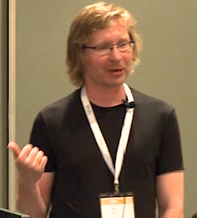
CppCon 2014 Pragmatic Type Erasure: Solving OOP Problems w/ Elegant Design Pattern--Zach Laine

While we wait for CppCon 2015 in September, we’re featuring videos of some of the 100+ talks from CppCon 2014. Here is today’s feature:

Pragmatic Type Erasure: Solving OOP Problems w/ Elegant Design Pattern

by Zach Laine

(watch on YouTube) (watch on Channel 9)

Summary of the talk:

There are numerous, serious OOP design problems that we have all encountered in production code. These include, among others: - object lifetime/ownership - how to make classes from different class hierarchies conform to a common interface - writing classes that can present multiple interfaces - separating interface and implementation - how to write virtual functions so that subclasses override them properly - the virtual inheritance "diamond of death"

Proper use of type erasure can mitigate, or outright eliminate, these and other problems, without sacrificing performance.

This talk will cover the OOP design problems above and more, and will cover hand-rolled and library-based type erasure approaches that solve those problems. Performance metrics will be provided for the different approaches, and source code will be available after the talk.

CppCon 2014 Embind and Emscripten: Blending C++11, JavaScript, and the Web Browser--Chad Austin

While we wait for CppCon 2015 in September, we’re featuring videos of some of the 100+ talks from CppCon 2014. Here is today’s feature:

Embind and Emscripten: Blending C++11, JavaScript, and the Web Browser

by Chad Austin

(watch on YouTube) (watch on Channel 9)

Summary of the talk:

Emscripten compiles C or C++ source code into JavaScript so it can run in a web browser. Emscripten is commonly used to port games to the web with no download or plugin required.

Embind is a C++11 binding library that makes it easy to expose libraries written in C++ to JavaScript. This allows JavaScript applications to take advantage of existing bodies of C++ code. In addition, C++ compiled into the asm.js subset of JavaScript is often faster than hand-written JavaScript, so Embind makes it convenient to accelerate JavaScript applications by writing high-performance functionality in C++.

With several motivating examples, this lecture will cover the design of embind, how variadic templates and constexpr facilitate interesting optimizations, and how embind minimizes its impact on the size of the generated JavaScript.

CppCast Episode 7: Quick Game Development with Vittorio Romeo -- Rob Irving

Episode 7 of CppCast the only podcast by C++ developers for C++ developers. In this episode Vittorio Romeo joins Rob Irving to talk about making simple games with C++ using libraries like SFML, SDL and Cinder.

CppCast Episode 7: Quick Game Development with Vittorio Romeo

by Rob Irving

About the interviewee:

Vittorio Romeo is an undergraduate Computer Science student at "Università degli Studi di Messina". Since childhood he has always been interested in programming, and learned to develop applications and games as an autodidact. After discovering C++ a few years ago, Vittorio became extremely passionate about its evolution and its community. He currently works on open-source general-purpose C++14 libraries and develops free open-source games. Vittorio also loves teaching: he manages a well-received C++11/C++14 video tutorial series and he talked about game development in C++ at CppCon 2014. When he's not in front of a computer, Vittorio enjoys fitness activities (weightlifting, swimming, running) and reading.

CppCon 2014 Introduction to C++ AMP (GPGPU Computing)--Marc Gregoire

While we wait for CppCon 2015 in September, we’re featuring videos of some of the 100+ talks from CppCon 2014. Here is today’s feature:

Introduction to C++ AMP (GPGPU Computing)

by Marc Gregoire

(watch on YouTube) (watch on Channel 9)

Summary of the talk:

Meet C++ AMP (Accelerated Massive Parallelism), an abstraction layer on top of accelerators such as GPUs. In its current version it allows you to run code on any DX11 GPU, independent of the vendor, and it will even distribute workload across GPUs of different vendors simultaneously. C++ AMP was originally designed by Microsoft but is now an open standard. C++ AMP can deliver orders of magnitude performance increase with certain algorithms by utilizing the GPU to perform mathematical calculations. This talk will give a high level overview of what C++ AMP is and what it can do for you. It is time to start taking advantage of the computing power of GPUs!

CppCon 2014 Rebuilding Boost Date-Time for C++11--Jeff Garland

While we wait for CppCon 2015 in September, we’re featuring videos of some of the 100+ talks from CppCon 2014. Here is today’s feature:

Rebuilding Boost Date-Time for C++11

by Jeff Garland

(watch on YouTube) (watch on Channel 9)

Summary of the talk:

Boost date_time is a widely used C++ library originally released in 2001 -- including being the basis for elements of the chrono library in c++11. While the library interface has stayed stable for more than a decade, the world around it has changed with the standard library and language changing. It is time for the library tobe rewritten to account for c++11.

The lecture describes in detail the design decisions and changes to the library for C++11. More generally it describes elements of design for a small valuetype library. Many of these considerations involve new features of C++11 and how they should be used. This includes noexcept, move construction/assignment (R-values), constexpr, enum classes, and user defined literals.

CppCast Episode 6: Fit and Tick with Paul Fultz II

Episode 6 of CppCast, the only podcast by C++ developers for C++ developers. In this episode Paul Fultz II joins Rob Irving to talk about his upcoming C++Now talk which will focus on the two C++ libraries hes created Fit and Tick.

CppCast Episode 6: Fit and Tick with Paul Fultz II

by Rob Irving

About the interviewee:

Paul Fultz II has developed in C++ professionally and personally in a variety of fields including DSP, web development, and desktop applications. He has developed in other languages as well such as Java, C#, Python, and Javascript but focuses most of his attention on C++ which combines correctness, expressiveness, and performance together.

CppCon 2014 Adventures In Updating A Legacy Codebase--Billy Baker

While we wait for CppCon 2015 in September, we’re featuring videos of some of the 100+ talks from CppCon 2014. Here is today’s feature:

Adventures In Updating A Legacy Codebase

by Billy Baker

(watch on YouTube) (watch on Channel 9)

Summary of the talk:

Still maintaining a legacy application? Do you have strdup()'s crying to be replaced with std::string? Do pre-standard headers such as iostream.h litter your code? Do boost libraries no longer compile with your favorite C++98 compiler? From GUIs to kernel drivers, this talk will look at some of the adventures taken while updating a codebase with more than 20 years of history to C++11.

CppCon 2014 Viewing The World Through Array-Shaped Glasses--Ɓukasz Mendakiewicz

While we wait for CppCon 2015 in September, we’re featuring videos of some of the 100+ talks from CppCon 2014. Here is today’s feature:

Viewing The World Through Array-Shaped Glasses

by Łukasz Mendakiewicz

(watch on YouTube) (watch on Channel 9)

Summary of the talk:

It's agreed among experts that the most performant data structure in C++ is an array. Or a vector. Or a dynarray. Indeed, until recently there was no standardized approach in C++ to view these types in an uniform manner. It was even murkier when the data had logically more than one dimension. This talk is an introduction to the new features proposed for C++17 in N3851 [TBD: update after Rapperswil] bringing all contiguous data into harmony and lifting it to higher dimensions: index, bounds, array_view and more. Attendees will also learn how indexable algorithms differ from the traditional elemental ones, and what does it mean for parallelism.

CppCon 2014 An Overview of C++11/14, Part II--Leor Zolman

While we wait for CppCon 2015 in September, we’re featuring videos of some of the 100+ talks from CppCon 2014. Here is today’s feature:

An Overview of C++11/14, Part II

by Leor Zolman

(watch on YouTube) (watch on Channel 9)

Summary of the talk:

This accelerated introduction to C++11/14 surveys most of the key additions to the C++ language, including support for increased code clarity (lambdas, uniform initialization, auto, new OOD control) and improved performance (rvalue references, move semantics and perfect forwarding.)

The presentation is designed for those who truly need a quick overview of the new C++, so the focus is on breadth rather than depth. Whenever feasible, new language features are presented in a style showcasing how they improve over their "Old C++" counterparts.

CppCon 2014 An Overview of C++11/14, Part I--Leor Zolman

While we wait for CppCon 2015 in September, we’re featuring videos of some of the 100+ talks from CppCon 2014. Here is today’s feature:

An Overview of C++11/14, Part I

by Leor Zolman

(watch on YouTube) (watch on Channel 9)

Summary of the talk:

This accelerated introduction to C++11/14 surveys most of the key additions to the C++ language, including support for increased code clarity (lambdas, uniform initialization, auto, new OOD control) and improved performance (rvalue references, move semantics and perfect forwarding.)

The presentation is designed for those who truly need a quick overview of the new C++, so the focus is on breadth rather than depth. Whenever feasible, new language features are presented in a style showcasing how they improve over their "Old C++" counterparts.