News

Trip report: C++ standards meeting in Jacksonville, Feb-Mar 2016 -- Herb Sutter

A comprehensive trip report from the just-concluded ISO C++ meeting:

Trip report: Winter ISO C++ standards meeting

by Herb Sutter

From the article:

On March 5, the ISO C++ committee completed its winter meeting in Jacksonville, FL, USA. We had record-tying attendance, with over 110 experts officially representing eight national bodies. As usual, we met for six days Monday through Saturday, and around the clock from 8:30am till 10pm most days, after which many people still went back to hang out in the lobby or their rooms to update papers. — The hotel had a baby grand piano outside the main meeting room lobby, and so late at night you could often walk by and find one of several committee members playing a tune, while as usual people collaborated on their proposals, perched on couches and tables clustered around glowing rectangles, incanting standardese to the soft strains of Russian folk ballads and arena rock.

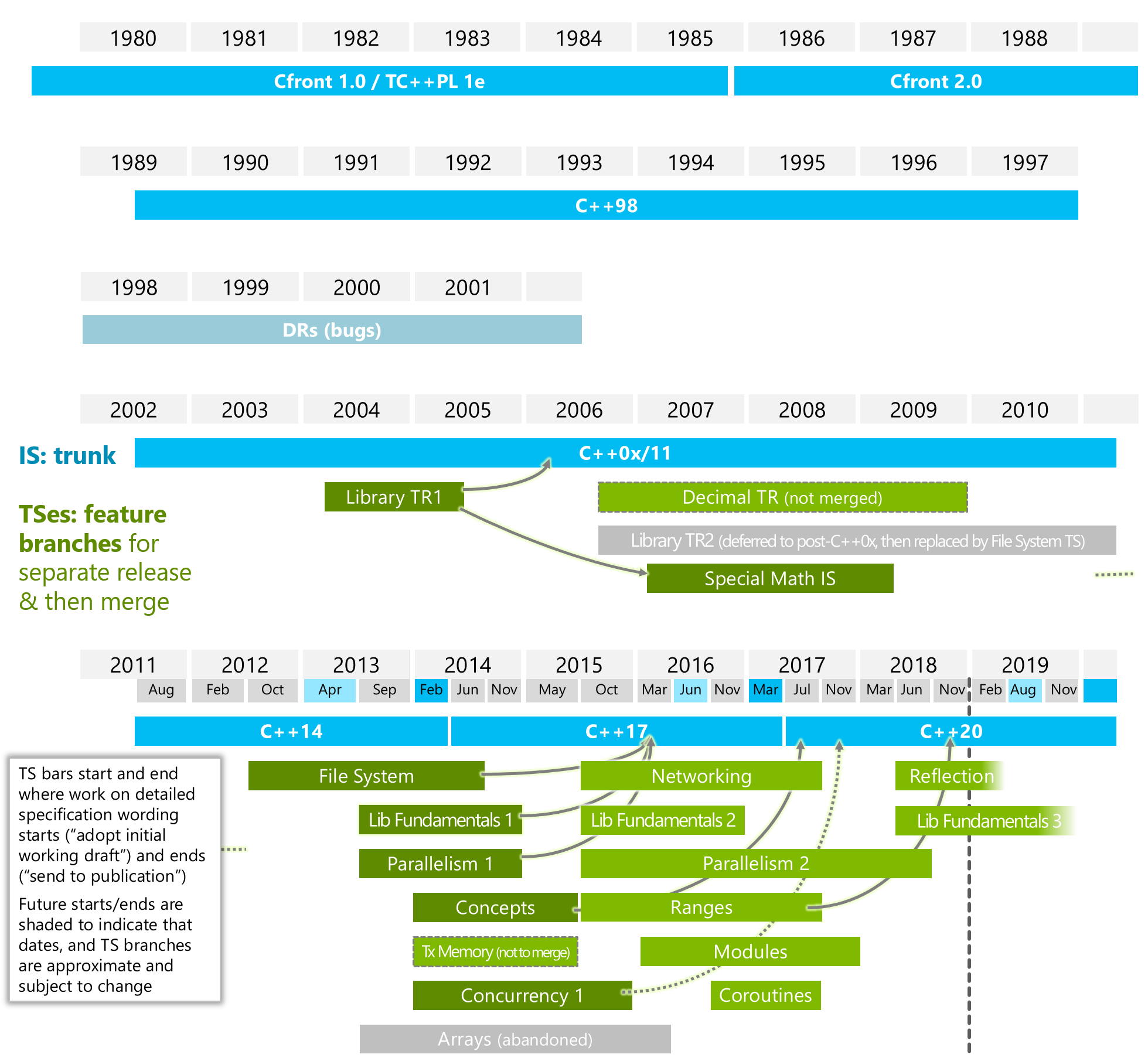
Here’s a summary of what happened, with some details about the current ISO C++ process so you can see just how the work is progressing and getting released. I’ve tried to add some links to the relevant feature design papers, or to the papers that summarize what was done which in turn usually carry more links to the design papers...
CppCast Episode 48: Clean Code with Arne Mertz

Episode 48 of CppCast the only podcast for C++ developers by C++ developers. In this episode Rob and Jason are joined by Arne Mertz to discuss Clean Coding techniques.

CppCast Episode 48: Clean Code with Arne Mertz

by Rob Irving and Jason Turner

About the interviewee:

Arne is a Software Engineer at Zühlke Engineering, a blogger and a clean code enthusiast. He has been maintaining and developing large financial C++ applications for several years. Arne has a diploma in physics and has written some scientific code for his degree courses in Fortran77 and C++ before he started his programming career. Currently he is broadening his view on the software development world by doing test automation, integration, requirements engineering and tooling for a large Java/JavaScript web application. To keep in touch with C++ he continues to write about it on his blog, reads other blogs and watches videos of conference talks.

In his free time he sings in a choir together with his wife and enjoys playing video games. He likes to travel a lot, especially tall ship sailing.

Building and Using Themis in PNaCl

Cossaclabs offers via their Themis framework to run C++ code inside browsers on x86 and now on ARM platforms.

Building and Using Themis in PNaCl

by cossacklabs

From the article:

Native Client (NaCl) allows browser applications to launch a native low-level code in an isolated environment. Thanks to this, some code, performance code parts can be rewritten in C or C++ easily. Until recent time, NaCl could work on x86-compatible systems only, yet supporting ARM platform becomes very important, because a huge variety of devices (especially the newest Chrome OS laptops), are built on ARM architecture.

All you need to compile the code for ARM is located in the latest Native Client SDK. However, using NaCl forces developers to include support for all used architectures. This is achieved by building NaCl separately for all the architectures supported. Then the browser chooses the correct object to launch, basing on the architecture information.

Despite the fact that ARM architecture support in NaCl is rapidly improving, we should note that while Samsung Chromebooks remain being a primary objective for NaCl developers, it’s too early to talk about adequate ARM architecture support.

Guidelines Support Library Review: span--Marius Bancila

Explanations on the span:

Guidelines Support Library Review: span<T>

by Marius Bancila

From the article:

The Guidelines Support Library is a Microsoft implementation of some of the types and functions described in the C++ Core Guidelines maintained by the Standard C++ Foundation. Among the types provided by the GSL is span<T> formerly known as array_view<T>. This article is an introduction to this type.

Code Browser by Woboq

Woboq presents the release of their C++ Code Browser.

Code Browser by Woboq

by Woboq

From the website:

This is an online C and C++ code browser. It focuses on improving the code navigation with proper semantic highlighting and tooltips.

  • Take the feature tour
  • Enable faster understanding of code
  • Get it for your own project

One can browse some open source projects like Qt, GLibc, LLVM, Boost, GCC, and Linux


Returning multiple values from functions in C++--Eli Bendersky

A valid question to ask when writing functions:

Returning multiple values from functions in C++

by Eli Bendersky

From the article:

Since C++ has no built-in syntax for returning multiple values from functions and methods, programmers have been using a number of techniques to simulate this when needed, and the number has grown since the introduction of C++11. In this post I want to provide an overview of some of the options we have today for returning multiple values from functions, and possible future directions in the language...

Trip Report C++ Meeting at Jacksonville -- J. Daniel Garcia

Here is Daniel's trip report from the recent C++ meeting at Jacksonville

Trip Report C++ Meeting at Jacksonville

by J. Daniel Garcia

From the article:

First of all the bad news. Unfortunately I have to say that the outcome of the standards meeting has been disappointing. Let me explain myself. We had a really very intense week here in Jacsonville. We made progress in many things, but  we will not have the killer features I really wanted for C++17.

In detail he sums the features that were not voted into C++17 and those that were accepted.