News

C++ User Group Meetings in October

The monthly overview on upcoming user group meetings:

C++ User Group Meetings in October

by Jens Weller

From the article:

    5.10 C++ UG Dublin - C/C++ Meeting with 3 Talks
    7.10 C++ UG Saint Louis - Intro to Unity\, Scott Meyers "gotchas"\, Group exercise
    7.10 C++ UG Washington, DC - Q & A / Info Sharing
    13.10 C++ UG New York - Joint October C++ Meetup with Empire Hacking
    14.10 C++ UG Utah - Regular Monthly Meeting
    14.10 C++ UG San Francisco/ Bay area - Presentation and Q&A
    19.10 C++ UG Austin - North Austin Monthly C/C++ Pub Social
    20.10 C++ UG Berlin - Thomas Schaub - Introduction to SIMD
    20.10 C++ UG Hamburg - JavaX (really?)
    21.10 C++ UG Washington, DC - Q & A / Info Sharing
    21.10 C++ UG Bristol - Edward Nutting
    21.10 C++ UG Düsseldorf - CppCon trip report & Multimethods
    21.10 C++ UG Arhus - Lego & C++
    24.10 C++ UG Italy - Clang, Xamarin, MS Bridge, Google V8
    28.10 C++ UG San Francisco/ Bay area - Workshop and Discussion Group
    29.10 C++ UG Bremen - C++ User Group

CppCast Episode 28: C++ Concurrency with Anthony Williams

Episode 28 of CppCast the only podcast for C++ developers by C++ developers. In this episode Rob and Jason are joined by Anthony Williams to discuss some of the Concurrency features of C++.

CppCast Episode 28: C++ Concurrency with Anthony Williams

by Rob Irving and Jason Turner

About the interviewee:

Anthony Williams is a UK-based developer and consultant with many years of experience in C++. He has been an active member of the BSI C++ Standards Panel since 2001, and is author or coauthor of many of the C++ Standards Committee papers that led up to the inclusion of the thread library in the new C++ Standard, known as C++11 or C++0x. He was the lead maintainer of boost thread from 2006 to 2011, and is the developer of the just::thread implementation of the C++11 thread library from Just Software Solutions Ltd. Anthony lives in the far west of Cornwall, England.

This years C++ Committee papers sorted by mailing and subgroup

An alternative listing of the papers sorted by mailing & subgroups:

This years C++ Committee papers sorted by mailing and subgroup

by Jens Weller

From the article:

I used to do overviews on all papers for a meeting, and when I find the time, I will do this for upcoming meetings again. I will try to post a best-of later, with all the good stuff on concepts, modules and more later. Currently I'm to busy, I just got back from CppCon, and will go to the Qt World Summit next week (meet me there!).

So, in the mean time you can take take a look for yourself, as what follows is the list off all papers submitted this year, sorted by mailings and then subgroups. My awesome paper crawler tool did finally its job correct...

CppCon 2015 videos also on Channel 9

CppCon 2015's sessions, panels, and lightning talks were professionally recorded and will be available online worldwide for free in about a month. As you probably saw already on this site, the team made a special effort to post the big five talks early -- the three keynotes and two other daily plenary sessions are all available online now.

To try to make the videos as widely available as possible, like last year the videos are being posted on two different sites: YouTube and Channel 9. Feel free to use whichever works best in your country.

Again, the rest of the talk videos will take about a month to post. The slides will also be available soon and you will be able to find them at github.com/cppcon/cppcon2015. Enjoy!

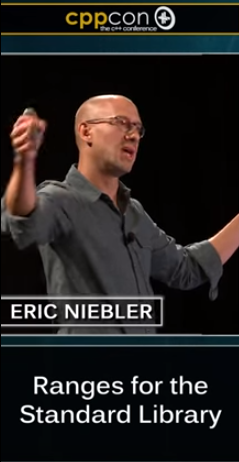
Video available: Eric Niebler, "Ranges for the Standard Library" -- CppCon 2015 Friday endnote

niebler-cppcon2015-v.PNGCppCon 2015's inspiring endnote video is now available below. This is last of the rush-processed plenary sessions posted quickly (see the Video feed for the others). Of course, there'll be more: Like last year, all the sessions, panels, and lightning talks were professionally recorded and will be available online worldwide for free, but processing well over 100 videos is a lot of work and it will take about a month before they can be available; your patience is appreciated.
Here is the talk, available on both YouTube and Channel 9 (use whichever works best in your country). Slides will be available soon at github.com/cppcon/cppcon2015:

Ranges for the Standard Library (YouTube) (Channel 9)

by Eric Niebler, CppCon 2015

From the talk's outline:

Range-based interfaces are functional and composable, and lead to code that is correct by construction. With concepts and ranges coming to the STL, big changes are in store for the Standard Library and for the style of idiomatic C++. The effort to redefine the Standard Library is picking up pace. Come hear about one potential future of the STL from one of the key people driving the change.

I've been doing C++ professionally for the past 20 years, first for Microsoft, then as an independent consultant. Right now, I'm working on bringing the power of "concepts" and "ranges" to the Standard Library with the generous help of the Standard C++ Foundation. Ask me about the future of the Standard Library, or about range-v3, my reference implementation for C++11.

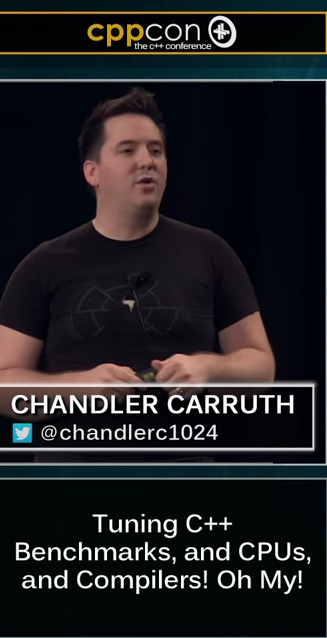
Video available: Chandler Carruth, "Tuning C++: Benchmarks, and CPUs, and Compilers!" -- CppCon

Chandler's talk about benchmarking, cheating the compiler's optimizer and optimizing code from the recent CppCon is online.

Tuning C++: Benchmarks, and CPUs, and Compilers! Oh My! (YouTube)

by Chandler Carruth, CppCon 2015

From the talk's outline:

A primary use case for C++ is low latency, low overhead, high performance code. But C++ does not give you these things for free, it gives you the tools to control these things and achieve them where needed. How do you realize this potential of the language? How do you tune your C++ code and achieve the necessary performance metrics?

This talk will walk through the process of tuning C++ code from benchmarking to performance analysis. It will focus on small scale performance problems ranging from loop kernels to data structures and algorithms. It will show you how to write benchmarks that effectively measure different aspects of performance even in the face of advanced compiler optimizations and bedeviling modern CPUs. It will also show how to analyze the performance of your benchmark, understand its behavior as well as the CPUs behavior, and use a wide array of tools available to isolate and pinpoint performance problems. The tools and some processor details will be Linux and x86 specific, but the techniques and concepts should be broadly applicable.

The Problem, The Culprits, The Hope--Tony “Bulldozer00” (BD00) DaSilva

This is another call to all C++ programmers, it is time to change!

The Problem, The Culprits, The Hope

by Tony “Bulldozer00” (BD00) DaSilva

From the article:

Bjarne Stroustrup’s keynote speech at CppCon 2015 was all about writing good C++11/14 code. Although “modern” C++ compilers have been in wide circulation for four years, Bjarne still sees:

I’m not an elite, C++ committee-worthy, programmer, but I can relate to Bjarne’s frustration...