News

Scaling with C++11 -- Edouard Alligand

cppnow13-alligand.PNGFrom the recent BoostCon/C++Now event. If you missed it there, check it out online. An updated version of this talk is also slated for the upcoming Meeting C++ this fall if you want to catch it in person.

Scaling with C++11

Edouard Alligand

As the number of cores per processor increases, software needs to be able to execute multiple tasks in parallel in order to benefit from Moore's law. This is not only a question of writing parallel algorithms, but also a matter of designing the application properly to reduce inter-thread dependencies. These dependencies may be very hard to find and are the results of decades of serial programming. Thus, writing truly scalable software is less a question of technical expertise than adopting the appropriate state of mind.

This presentation is about the design, techniques and tools used by the team who wrote the hyperscalable database "quasardb." Building upon concrete scalability challenges, the presenter will expose typical multithreading anti-patterns and how to avoid them. The topics covered include: atomics, micro locks, lock-free and wait-free containers, memory management strategies (copy on write, smart pointers, perfect forwarding...), thread local storage, asynchronous I/O, and much more!

Explicit Is Better Than Implicit -- K-ballo

tales-of-cpp.PNGTales of C++, Episode 5:

Explicit Is Better Than Implicit

The Zen of Python tell us that Explicit is better than Implicit. This is good advice for any and all languages, but what are the implications in the C++ lands? There is one particular C++ feature that relates directly to that advice; one important enough that grants on its own the introduction of a keyword. That feature is user-defined conversions and that keyword is explicit.

C++ and Beyond 2013 is sold out

cb13-soldout.pngAs interest in C++ continues to increase, not only are we seeing more C++ events, but they’re selling out quickly. This spring, both the Clang/LLVM developer conference and C++ Now 2013 (formerly BoostCon) were sold out long in advance.

Today, C++ and Beyond 2013 reported it has sold out nearly six months in advance. A waitlist is available.

If you missed registering for C++ and Beyond, check out additional C++ events coming up around the world in the Upcoming Events section on the sidebar. More major C++ events in Fall 2013 will be announced shortly...

LLVM 3.3 is released!

You can download either the source or prebuilt executables from the LLVM web site
Clang 3.3 includes full C++11 support, as well as a suite of run-time checkers to help find bugs in your programs.

For more information, check out the release notes for LLVM and for Clang

Meeting C++ 2013 full schedule is available

meeting-c++.PNGThe complete schedule has now been posted for the Meeting C++ conference to be held on November 8-9 in Düsseldorf, Germany.

The conference includes talks by ISO C++ standards committee members like Eric Niebler, Peter Sommearlad, Peter Gottschling, and more. Here are a just a few highlights:

  • Keynote: C++11 and No-Compromise Library Design (Eric Niebler)
  • Simpler Code through C++11 (Peter Sommerlad)
  • Scaling with C++11 (Edouard Alligand)
  • Modern C++ Network Programming (Glyn Matthews)
  • UI prototyping and development for multiple devices in C++ (John Thomas)
  • C++1y: Concepts Lite (Peter Sommerlad)

See the announcement for additional interesting talks.


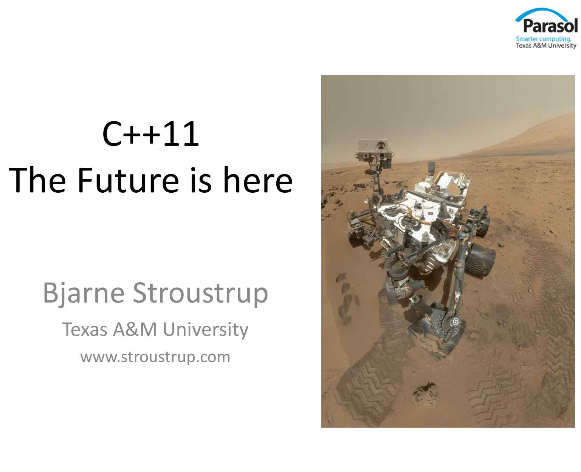
C++11: The Future Is Here -- Bjarne Stroustrup

stroustrup-accu2013.PNGStroustrup's ACCU keynote video is now available online.

C++11: The Future Is Here

Bjarne Stroustrup

Summary: Bjarne Stroustrup keynotes on what C++ is in general, how C++11 makes simple things even simpler, resource management, generic programming, and concurrency.

Regular Expressions 101: Regex in C++11 -- Brian Overland

overland_brian_c.jpgNew at InformIT:

Regular Expressions 101: Regex in C++11

by Brian Overland

From the article:

... You don't really need to know how it works. In fact, you only need to know a few things:

  • The regular expression grammar used by the C++11 regex library functions
  • The relevant C++11 functions and how to call them

The first part of this article focuses on the default regex grammar used in C++11: the ECMAScript grammar. You'll generally want to use ECMAScript, because it provides powerful capabilities while being easy to use. For simplicity, I'll focus on this grammar. ...

GotW #93 Solution: Auto Variables, Part 2 -- Herb Sutter

The solution to the latest GotW problem is now available:

GotW #93 Solution: Auto Variables, Part 2

by Herb Sutter

From the article:

As you worked through these cases, perhaps you noticed a pattern: The cases are mostly very different, but what they have in common is that they illustrate reason after reason motivating why (and how) to use auto to declare variables.

Let’s dig in and see...