
February 2026

IIFE for Complex Initialization -- Bartlomiej Filipek
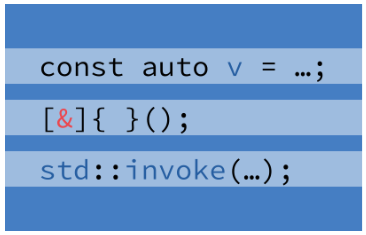
filipek-iife.pngWhat do you do when the code for a variable initialization is complicated? Do you move it to another method or write inside the current scope? Bartlomiej Filipek presents a trick that allows computing a value for a variable, even a const variable, with a compact notation.

IIFE for Complex Initialization

by Bartlomiej Filipek

In this article:

I hope you’re initializing most variables as const (so that the code is more explicit, and also compiler can reason better about the code and optimize).

For example, it’s easy to write:

const int myParam = inputParam * 10 + 5; 

or even:

const int myParam = bCondition ? inputParam*2 : inputParam + 10; 

But what about complex expressions? When we have to use several lines of code, or when the ? operator is not sufficient.

‘It’s easy’ you say: you can wrap that initialization into a separate function.

While that’s the right answer in most cases, I’ve noticed that in reality a lot of people write code in the current scope. That forces you to stop using const and code is a bit uglier.

PVS-Studio 7.41: MISRA C 2023, enhanced Unreal Engine integration, new logging system

PVS-Studio 7.41 has been released. It brings improvements for Unreal Engine, support for MISRA C 2023, an update to the IntelliJ IDEA plugin, and other useful changes.

PVS-Studio 7.41: MISRA C 2023, enhanced Unreal Engine integration, new logging system, and much more

by Valerii Filatov

From the article:

Throughout the year, we have been working to cover more of the MISRA C 2023 standard. Currently, PVS-Studio analyzer covers 86% of the standard. You can find more information on this page. In future releases, we will continue to expand MISRA C++ 2023 standard coverage.


Range adaptors – 5 years after C++20 -- Hannes Hauswedell

A look back on major design decisions in C++ Ranges and how they may be viewed today.

Range adaptors - 5 years after C++20

by Hannes Hauswedell

Watch now:

<iframe allow="accelerometer; autoplay; clipboard-write; encrypted-media; gyroscope; picture-in-picture; web-share" allowfullscreen="" frameborder="0" height="315" referrerpolicy="strict-origin-when-cross-origin" src="https://www.youtube-nocookie.com/embed/nficAvk5RA4?si=w86EVk7oX89uVcPg" title="YouTube video player" width="560"></iframe>

So how do you quickly concatenate strings? -- Aleksandr Orefkov

So how do you quickly concatenate strings?

By Aleksandr Orefkov

From the article:

All practicing programmers have to concatenate strings. Precisely concatenate, we don’t have some JavaScript or PHP, in C++ we have this fancy word for it. Programmers in other languages ​​simply “add” strings together without much thought, without even thinking about this operation. After all, what could be simpler than

return "The answer is " + str_answer + ", count is " + count;

But while it’s forgivable for script kiddies not to think about the meaning behind such a simple notation, it’s unacceptable for an experienced developer to approach such an important issue so irresponsibly. An experienced developer, imagining such C++ code, immediately sees the terrifying abyss of problems that such an approach can create.

What type is str_answer? What type is count? “The answer is “ and “, count is “ - are literals that add to std::string as a const char*. So, strlen will be called. I wonder if the compiler will be able to optimize and calculate their length at compile time? Oh well, it seems like constexpr is in the addition, let’s hope so.
This is the first level of problems for now. And let’s say we successfully solved them, creating the following code:

std::string make_answer(std::string_view str_answer, int count) {
    return "The answer is " + std::string{str_answer}
        + ", count is " + std::to_string(count);
}

It sounds like “Hurray!”, but it’s somehow not loud enough…

15 Different Ways to Filter Containers in Modern C++ -- Bartłomiej Filipek

logo.pngFiltering items from a container is a common situation. Bartłomiej Filipek demonstrates various approaches from different versions of C++.

15 Different Ways to Filter Containers in Modern C++

by Bartłomiej Filipek

From the article:

Do you know how many ways we can implement a filter function in C++? While the problem is relatively easy to understand – take a container, copy elements that match a predicate and the return a new container – it’s good to exercise with the C++ Standard Library and check a few ideas. We can also apply some modern C++ techniques, including C++23. Let’s start!

The problem statement

To be precise by a filter, I mean a function with the following interface:

  auto Filter(const Container& cont,
              UnaryPredicate p) {}

It takes a container and a predicate, and then it creates an output container with elements that satisfy the predicate. We can use it like the following:

  const std::vector<std::string> vec{
    "Hello", "**txt", "World", "error", "warning",
    "C++", "****" };
  auto filtered = Filter(vec, [](auto& elem) {
    return !elem.starts_with('*'); });
    // filtered should have "Hello", "World",
    // "error", "warning", "C++"

Writing such a function can be a good exercise with various options and algorithms in the Standard Library. What’s more, our function hides internal things like iterators, so it’s more like a range-based version.

Coroutines – A Deep Dive -- Quasar Chunawala

logo.pngCoroutines are powerful but require some boilerplate code. Quasar Chunawala explains what you need to implement to get coroutines working.

Coroutines – A Deep Dive

by Quasar Chunawala

From the article:

Following on from the introduction in the editorial, let’s understand the basic mechanics needed to code up a simple coroutine, and I’ll show you how to yield from the coroutine and await results.

The simplest coroutine

The following code is the simplest implementation of a coroutine:

  #include <coroutine>
  void coro_func(){
    co_return;
  }
  int main(){
    coro_func();
  }

Our first coroutine will just return nothing. It will not do anything else. Sadly, the preceding code is too simple for a functional coroutine and it will not compile. When compiling with gcc 15.2, we get the error shown in Figure 1.

<source>: In function 'void coro_func()':
<source>:4:5: error: unable to find the promise type for this coroutine
    4 |     co_return;
      |     ^~~~~~~~~
 
Looking at C++ reference, we see that the return type of a coroutine must define a type named promise_type. Why do we need a promise? The promise_type is the second important piece in the coroutine mechanism. We can draw an analogy from futures and promises which are essential blocks for achieving asynchronous programming in C++. The future is the thing, that the function that does the asynchronous computation, hands out back to the caller, that the caller can use to retrieve the result by invoking the get() member function. The future has the role of the return object. 

Concurrency Flavours -- Lucian Radu Teodorescu

logo.pngConcurrency has many different approaches. Lucian Radu Teodorescu clarifies terms, showing how different approaches solve different problems.

Concurrency Flavours

by Lucian Radu Teodorescu

From the article:

Most engineers today use concurrency – often without a clear understanding of what it is, why it’s needed, or which flavour they’re dealing with. The vocabulary around concurrency is rich but muddled. Terms like parallelism, multithreading, asynchrony, reactive programming, and structured concurrency are regularly conflated – even in technical discussions.

This confusion isn’t just semantic – it leads to real-world consequences. If the goal behind using concurrency is unclear, the result is often poor concurrency – brittle code, wasted resources, or systems that are needlessly hard to reason about. Choosing the right concurrency strategy requires more than knowing a framework or following a pattern – it requires understanding what kind of complexity you’re introducing, and why.

To help clarify this complexity, the article aims to map out some of the main flavours of concurrency. Rather than defining terms rigidly, we’ll explore the motivations behind them – and the distinct mindsets they evoke. While this article includes a few C++ code examples (using features to be added in C++26), its focus is conceptual – distinguishing between the flavours of concurrency. Our goal is to refine the reader’s taste for concurrency.