CppCon 2019 Trip Report and Slides--Anthony Williams
Check it out!
CppCon 2019 Trip Report and Slides
by Anthony Williams
From the article:
Having been back from CppCon 2019 for over a week, I thought it was about time I wrote up my trip report...
June 8-13, Brno, Czechia
June 17-20, Folkestone, UK
September 12-18, Aurora, CO, USA
November 16-21, Búzios, Rio De Janeiro, Brazil
November 26-28, Berlin, Germany
By Adrien Hamelin | Oct 2, 2019 11:20 AM | Tags: community
Check it out!
CppCon 2019 Trip Report and Slides
by Anthony Williams
From the article:
Having been back from CppCon 2019 for over a week, I thought it was about time I wrote up my trip report...
By Sergey Platonov | Sep 23, 2019 12:52 PM | Tags: None
C++ Russia 2019 Piter will be held in Saint-Petersburg, October 31 – November 1, 2019.
C++ Russia 2019
From the article:
Two days, three tracks and dozens of in-depth technical talks about C++: concurrency, performance, architecture, environment — all you need to make your code perfect.
Keynote by Sean Parent, Eric Niebler and Ivan Čukić.
Also at the conference: Marshall Clow, Björn Fahller, Maxim Khizhinsky, Hana Dusíková, Rainer Grimm and many others.
C++ Russia is not only the talks but also networking with hundreds of colleagues from Russia and Europe. Due to dedicated discussion zones, all the speakers have after their talks, all the questions will be answered.And in the evening you can participate in BoF-sessions where the most uncommon ideas are born.
Fourteen talks will be entirely in English.
By Adrien Hamelin | Sep 23, 2019 11:58 AM | Tags: community
 What do you think about it?
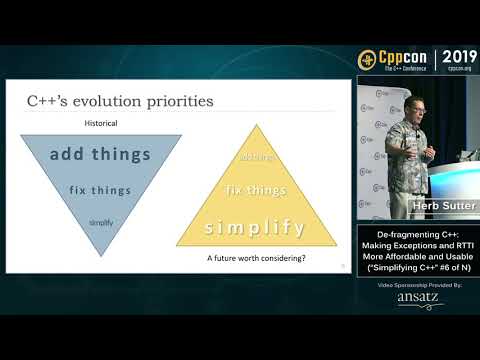
De-fragmenting C++: Making Exceptions and RTTI More Affordable and Usable
by Herb Sutter
From the video:
A fundamental reason why C++ is successful and loved is its adherence to Stroustrup’s zero-overhead principle: You don’t pay for what you don’t use, and if you do use a feature you can’t reasonably code it better by hand. In the C++ language itself, there are only two features that violate the zero-overhead principle, exception handling and RTTI – and, unsurprisingly, these are also the only two C++ language features that every C++ compiler has switches to turn off and that are regularly discouraged or even banned. This matters because not using these features is the largest current cause of fragmentation of the C++ community into incompatible dialects, and the cause of recurring problems including type confusion security vulnerabilities arising from “didn’t down-cast using dynamic_cast because that would be too slow.” This talk is about ongoing long-term efforts to try to unify the community in this area, not by replacing exceptions and RTTI, but by doubling down: fully embracing exceptions and RTTI, and improving them so they can be zero-overhead too.
By Adrien Hamelin | Sep 23, 2019 11:56 AM | Tags: community
 More are coming!
Better Code: Relationships
by Sean Parent
From the video:
Computer scientists are bad at relationships. Nearly every program crash is rooted in a mismanaged relationship, yet we spend most of our time discussing types and functions and not the relationships connecting them together. This talk looks at common ways data and code are connected in an application, how those relationships are typically represented, and the problems caused by the use, and misuse of these paradigms. Then we'll look at ways to model these relationships in C++ and use them to build correct applications.
By Adrien Hamelin | Sep 23, 2019 11:54 AM | Tags: community
The first report is already in!
CppCon 2019 Trip Report
by Matt Godbolt
From the article:
I’m on my way back from the 2019 CppCon conference and my head is buzzing with ideas! What an amazing experience!
By Adrien Hamelin | Sep 19, 2019 12:04 PM | Tags: None
 The first videos are becoming available.
Applied WebAssembly: Compiling and Running C++ in Your Web Browser
by Ben Smith
From the video:
WebAssembly is a new technology in all modern browsers designed to let you run high-performance code. Maybe you've heard of WebAssembly before, read an article or two, or even tried to use it with your software project. Since WebAssembly is a low-level language, it's easy to get bogged down in the technical details, and leave without knowing whether WebAssembly will be useful for you. In this talk, I'll take a top-down approach, showing a real problem and how WebAssembly can help.
From August to December this year, I'll be teaching C++ to students at Morehouse College. Having a tool like Compiler Explorer is invaluable as a teaching aid, since it allows the students to immediately see C++ compilation results, on any device that has a web browser. But Compiler Explorer and tools like it require a server to do compilation, so they're hard to use offline. With WebAssembly, we can run the compiler client-side, in the browser, no server required.
First, I'll show how I ported the clang compiler and linker to WebAssembly. Since Clang 8 supports WebAssembly as a compilation target, we can even run the resulting executable sandboxed in the browser. Next, we'll dive into how Clang compiles C++ constructs into WebAssembly. Finally, we'll look at some of the new WebAssembly features in development.
By Adrien Hamelin | Sep 18, 2019 12:38 PM | Tags: community
 The first videos are arriving!
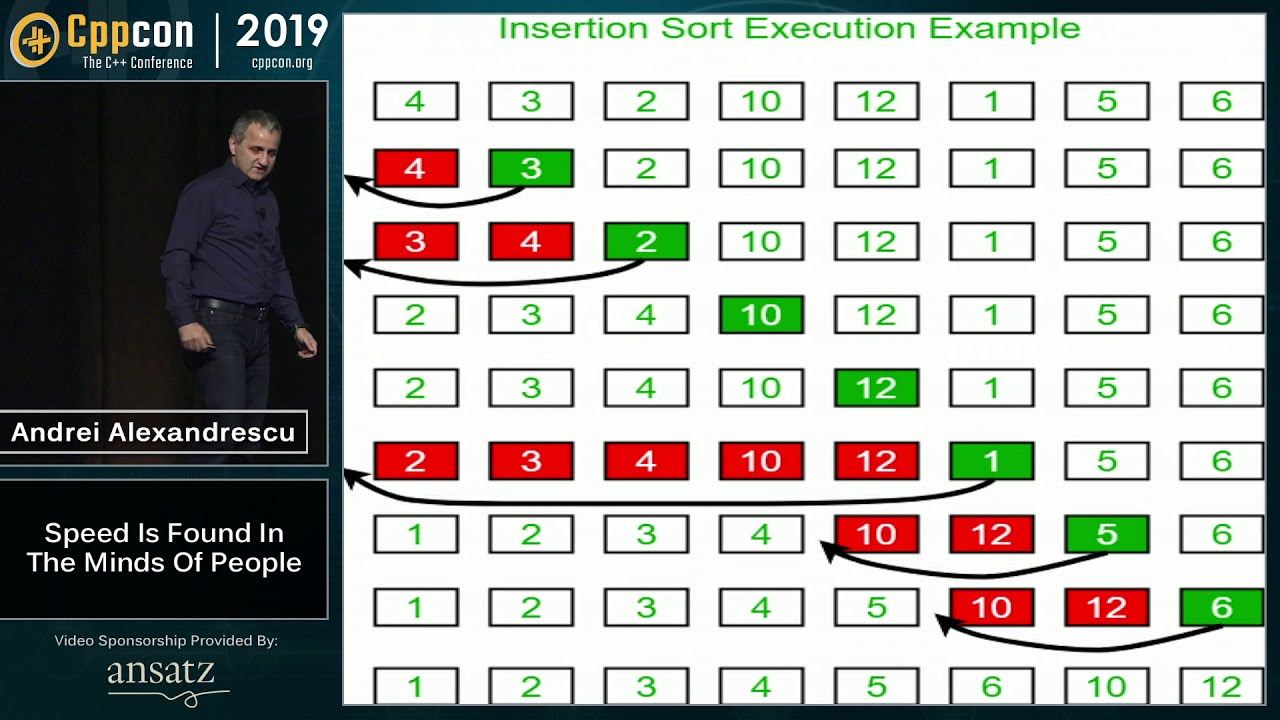
Speed Is Found In The Minds of People
by Andrei Alexandrescu
From the video:
In all likelihood, sorting is one of the most researched classes of algorithms. It is a fundamental task in Computer Science, both on its own and as a step in other algorithms. Efficient algorithms for sorting and searching are now taught in core undergraduate classes. Are they at their best, or is there more blood to squeeze from that stone? This talk will explore a few less known – but more allegro! – variants of classic sorting algorithms. And as they say, the road matters more than the destination. Along the way, we'll encounter many wondrous surprises and we'll learn how to cope with the puzzling behavior of modern complex architectures.
By Adrien Hamelin | Sep 16, 2019 12:05 PM | Tags: community
It started!
Back to Basics at CppCon 2019
by Arthur O’Dwyer
From the article:
Tomorrow I’ll be flying out to Denver, Colorado, for CppCon 2019. This will be my busiest CppCon yet! Besides giving my “STL From Scratch” weekend course for the third year in a row, this year I’m also the chair of CppCon’s new “Back to Basics” track...
By Adrien Hamelin | Sep 11, 2019 11:50 AM | Tags: experimental community
 We’re in the final countdown to this year’s CppCon, which starts on September 16. To whet your appetite for this year’s conference, here’s another of the top-rated talks from last year. Enjoy – and register today for CppCon 2019!
Nano-coroutines to the Rescue! (Using Coroutines TS, of Course)
by G. Nishanov
Summary of the talk:
Are you doing memory lookups in a huge table?
Does your embarrassingly random access to your lookup tables lead to memory stalls?Fear no more!
We will explore techniques that allow us to do useful work while the prefetcher is busily working on bringing the requested cache lines from main memory, by utilizing nano-coroutines.
And the best part, nano-coroutines can be easily implemented using Coroutines TS that is already available in MSVC and Clang compilers. With a little bit of library support we can utilize the coroutines to extract intra-thread parallelism and quadruple the speed up your lookups.
By Adrien Hamelin | Sep 11, 2019 11:41 AM | Tags: community
Will you attend?
Tool Time 2019
by Jon Kalb
From the article:
Similar to tech labs at some other events, we’re offering the opportunity for anyone, from an author/creator, to a vendor, to a super-user, to represent a tool (app, library, framework, or service) and run their own table answering questions or showing demos...