
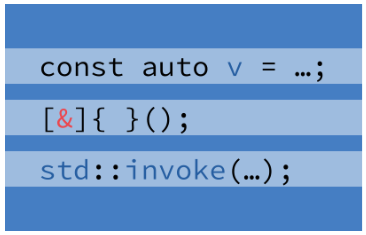
 What do you do when the code for a variable initialization is complicated? Do you move it to another method or write inside the current scope? Bartlomiej Filipek presents a trick that allows computing a value for a variable, even a const variable, with a compact notation.
IIFE for Complex Initialization
by Bartlomiej Filipek
In this article:
I hope you’re initializing most variables as
const(so that the code is more explicit, and also compiler can reason better about the code and optimize).For example, it’s easy to write:
const int myParam = inputParam * 10 + 5;or even:
const int myParam = bCondition ? inputParam*2 : inputParam + 10;But what about complex expressions? When we have to use several lines of code, or when the
?operator is not sufficient.‘It’s easy’ you say: you can wrap that initialization into a separate function.
While that’s the right answer in most cases, I’ve noticed that in reality a lot of people write code in the current scope. That forces you to stop using
constand code is a bit uglier.
Add a Comment
Comments are closed.