experimental

Support for C++20’s Concepts in CLion--Anastasia Kazakova

Are you using it?

Support for C++20’s Concepts in CLion

by Anastasia Kazakova

From the article:

Concepts are one of the biggest features coming in C++20, and knowing that, we’ve been thinking about supporting Concepts in CLion for quite a while. Enter Saar Raz with his C++20’s Concepts implementation in Clang! Long story short, we have been collaborating with Saar to merge his branch into our custom Clangd-based language engine in CLion, and started implementing some nice IDE features on top. Sounds ambitious enough, but we have thoroughly enjoyed the experience so far! A very early result of this collaboration was used by Saar in his CppCon 2019 talk on Concepts...
C++20 span tutorial--Paul Silisteanu

All you need to know.

C++20 span tutorial

by Paul Silisteanu

From the article:

According to the latest C++20 draft, a span is a non-owning view over a contiguous sequence of objects. In other words, a std::span is, in essence, a pointer, length pair that gives the user a view into a contiguous sequence of elements. The elements of a span can be, for example, stored in one of the standard library sequential containers (like std::array, std::vector), in a built-in C-style array or in a memory buffer...

C++ 20: The Core Language--Rainer Grimm

Many changes for the better.

C++ 20: The Core Language

by Rainer Grimm

From the article:

My last post C++20: The Big Four started with an overview of concepts, ranges, coroutines, and modules. Of course, C++20 has more to offer. Today, let's continue my overview of the core language...

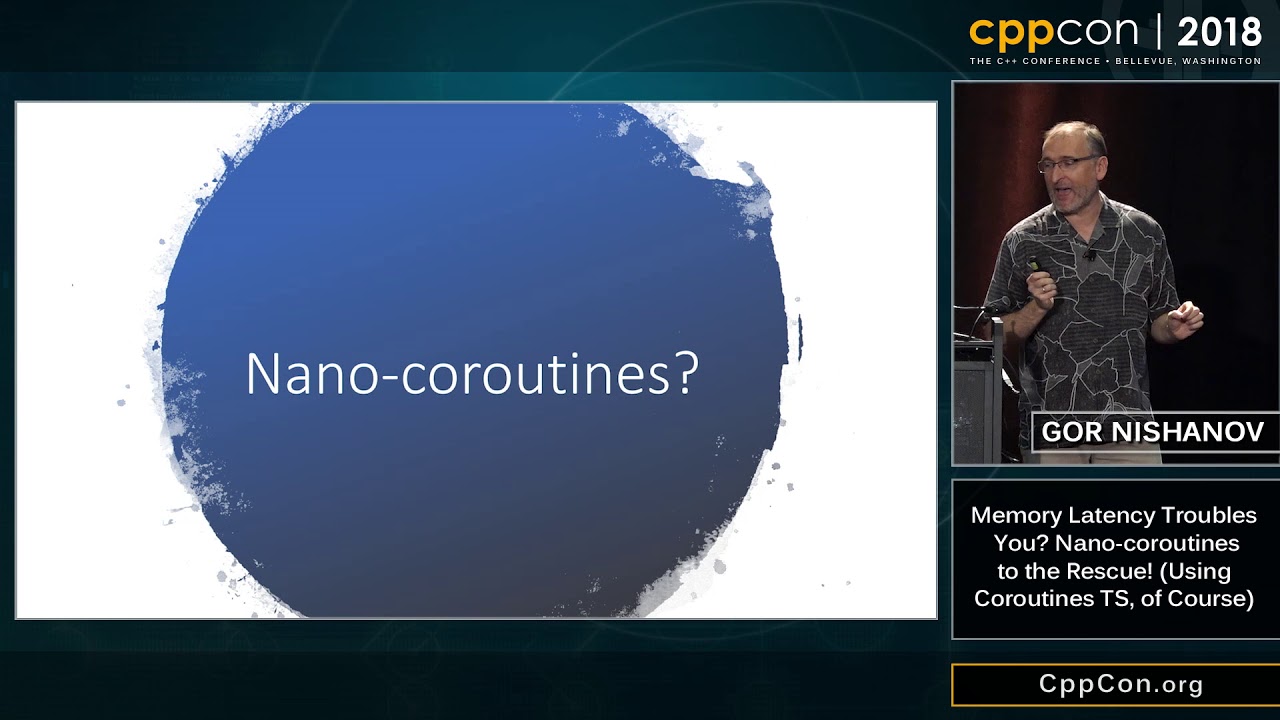
CppCon 2018: Nano-coroutines to the Rescue! (Using Coroutines TS, of Course)--G. Nishanov

We’re in the final countdown to this year’s CppCon, which starts on September 16. To whet your appetite for this year’s conference, here’s another of the top-rated talks from last year. Enjoy – and register today for CppCon 2019!

Nano-coroutines to the Rescue! (Using Coroutines TS, of Course)

by G. Nishanov

Summary of the talk:

Are you doing memory lookups in a huge table?
Does your embarrassingly random access to your lookup tables lead to memory stalls?

Fear no more!

We will explore techniques that allow us to do useful work while the prefetcher is busily working on bringing the requested cache lines from main memory, by utilizing nano-coroutines.

And the best part, nano-coroutines can be easily implemented using Coroutines TS that is already available in MSVC and Clang compilers. With a little bit of library support we can utilize the coroutines to extract intra-thread parallelism and quadruple the speed up your lookups.