News

C++ to JavaScript with Emscripten

Want to run your C++ code in a browser? Check out this project that converts LLVM bitcode to JavaScript™. From the project homepage:

Emscripten is an LLVM to JavaScript™ compiler. It takes LLVM bitcode (which can be generated from C/C++ using Clang, or any other language that can be converted into LLVM bitcode) and compiles that into JavaScript™, which can be run on the web (or anywhere else JavaScript™ can run).

Using Emscripten, you can

  • Compile C and C++ code into JavaScript™ and run that on the web
  • Run code in languages like Python as well, by compiling CPython from C to JavaScript™ and interpreting code in that on the web

They even have Qt demos running!

Continue reading...

What new capabilities do user-defined literals add to C++? -- StackOverflow

Over the past year, UDLs have started to become available in some popular C++ compilers, including gcc 4.7 and Clang 3.1. As people are adopting those compilers in real code and starting to be ablel to use this feature, a natural question is how useful they are and how to use them:

What new capabilities do user-defined literals add to C++?

C++11 introduces user-defined literals which will allow the introduction of new literal syntax based on existing literals (int, hex, string, float) so that any type will be able to have a literal presentation.

Examples:

// imaginary numbers
std::complex<long double> operator "" _i(long double d) // cooked form
{
    return std::complex<long double>(0, d);
}
auto val = 3.14_i; // val = complex<long double>(0, 3.14)

// binary values
int operator "" _B(const char*); // raw form
int answer = 101010_B; // answer = 42

// std::string
std::string operator "" _s(const char* str, size_t /*length*/)
{
    return std::string(str);
}
auto hi = "hello"_s + " world"; // + works, "hello"_s is a string not a pointer

// units
assert(1_kg == 2.2_lb); // give or take 0.00462262 pounds

At first glance this looks very cool but I'm wondering how applicable it really is, [...] do you feel this feature will justify itself? What other literals would you like to define that will make your C++ code more readable?

Quick Q: Why isn't std::initializer_list a core-language built-in? -- StackOverflow

Quick A: Because it doesn't have to be. It's "the C++ way" to prefer library solutions, and initializer_list shows how far you can get with a pure library solution, then the rest of the way with minimal language support to create initializer_list objects.

Recently on SO:

Why isn't std::initializer_list a core-language built-in?

It seems to me that it's quite an important feature of C++11 and yet it doesn't have its own reserved keyword (or something alike).


Instead, initializer_list it's just a template class from the standard library that has a special, implicit mapping from the new braced-init-list {...} syntax that's handled by the compiler.

At first thought, this solution is quite hacky. ...

The Importance of std::function -- Malte Skarupke

See also "Generalizing Observer", written ten years ago when std::function was first adopted.

The Importance of std::function

by Malte Skarupke

... Classically an update loop would be implemented something like this: ...

And this is a good solution at first. But you’ve got that inheritance in there, and that doesn’t scale. You will probably want to add a render loop and maybe a separate update loop for the editor. Once you’ve got that many base classes it makes sense to combine them into one. And now you’ve just started on the way of having a big base class that gets used everywhere. Soon enough adding something different to the update loop involves a whole lot of unnecessary work.

Here is an alternate update loop using std::function: ...


C++ and Xcode 4.6 -- from Marshall Clow

Marshall Clow gives some helpful tips for C++ programmers migrating to to XCode 4.6:

C++ and XCode 4.6

So, you’ve installed Xcode 4.6, and you are a C++ programmer.

You want to use the latest and greatest, so you create a new project, and add your sources to the project, and hit Build, and … guess what? Your code doesn’t build!

Continue reading...


Where is C++ used, besides everywhere? -- David Intersimone

From David I's blog at Embarcadero, a nice summary of where C++ is used with links to more... the next best thing to a "C++ inside" logo.

Multi-Device C++ is used everywhere on planet Earth and beyond!

In my conversation with Bjarne Stroustrup during the CodeRage 7 C++ Conference (replays of the sessions are available to watch and download) last December, Bjarne talked about how pervasive C++ is in enterprises, infrastructures, major application software and operating platforms. C++ is used to build Operating Systems, Libraries, Applications and Scalable Systems.  C++ is used in many different markets on planet Earth and beyond...


Image Watch: C++ image and video debugging plug-in for VS 2012

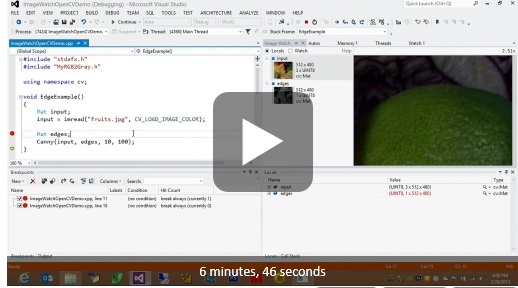
We continue to see modern C++ tool development across the industry continue apace. Here's another new cool C++-oriented tool with a nice seven-minute video on Channel 9:

Introducing Image Watch - A VS 2012 Plug-In for C++ Image and Video Debugging

Image Watch is a new Visual Studio 2012 plug-in for debugging C++ image and video processing applications, for example photo or augmented reality apps. Image Watch provides a watch window that can display in-memory bitmaps during debugging, so you no longer need to litter your code with "save-this-intermediate-image-to-a-file" statements when tracking down bugs. The initial release has built-in support for OpenCV image types and can be extended for viewing user-defined image types as well.

Here, Wolf Kienzle, Senior Research Developer, Interactive Visual Media group, Microsoft Research Redmond, explains and demos this excellent new tool for C++ developers building image, video or augmented reality apps. In effect, you can step into pixels...

No, really, moving a return value is easy -- StackOverflow

People new to C++11 often hear about move semantics, and expect that they have to do work to take advantage of it. That's often not true, and often the cleanest, simplest code that doesn't even mention move or && anywhere is just what you want -- that's C++11, clean, safe, and faster than ever.

Perhaps the most common case (and question) involves returning values from functions. The new rule for modern C++ style: Just return even big objects by value, and move Just Happens.

It just came up again on StackOverflow:

C++11 rvalues and move semantics confusion

The link skips straight to Howard Hinnant's clear and correct answer.

Sometimes we just try too hard, because we expect efficient programming not to be easy. Welcome to C++11.

last.fm releases moost -- a Boost-like library for music

Another step forward in C++ community libraries, joining others including Facebook's and Microsoft's OSS C++ work. This from last.fm last week:

All our tools are belong to you (last.fm)

by Marcus Holland-Moritz

Today we’re releasing moost, a C++ library with all the nice little tools and utilities our MIR team has developed over the past five years. If you’re a C++ developer yourself, you might notice that moost sounds quite similar to boost, and that’s on purpose. moost is the MIR team’s boost, there is hardly a project in our codebase that doesn’t depend on one or more parts of moost.

There are a lot of different things in moost...

Continue reading...