
News

Lambdas vs. Closures -- Scott Meyers

This bears repeating:

Lambdas vs. Closures

by Scott Meyers

From the article:

In recent days, I've twice found myself explaining the difference between lambdas and closures in C++11, so I figured it was time to write it up. ...

GotW #5 Solution: Overriding Virtual Functions -- Herb Sutter

The solution to GotW #5 is now available:

GotW #5 Solution: Overriding Virtual Functions (updated for C ++11/14)

by Herb Sutter

From the article:

Exactly one of the following can be true for a polymorphic type:

  • Either destruction via a pointer to base is allowed, in which case the function has to be public and had better be virtual;
  • or else it isn’t, in which case the function has to be protected (private is not allowed because the derived destructor must be able to invoke the base destructor) and would naturally also be nonvirtual (when the derived destructor invokes the base destructor, it does so nonvirtually whether declared virtual or not).

C++Now 2013 Trip Report -- Jens Weller

Reporting from the just-concluded C++Now 2013 event:

C++ Now 2013 -- Trip Report

by Jens Weller

From the article:

This years sessions focused a lot on threading, which brought great talks about atomics, transactional memory or C++11 threading to the conference. I have to admit, that threading is not my main interest in C++, so not all of those talks were meant for me. But having three tracks always gives you a great choice. And also gave me the confidence that the decision to go for 3 tracks at this years Meeting C++ conference was right.

GotW #4 Solution: Class Mechanics -- Herb Sutter

The solution to GotW #4 is now available:

GotW #4 Solution: Class Mechanics (updated for C++11/14)

by Herb Sutter

From the article:

... To see why, consider the following canonical forms for how operator+= and operator+ should normally be implemented for some type T.
T& T::operator+=( const T& other ) {
    //...
    return *this;
}


T operator+( T a, const T& b ) {
    a += b;
    return a;
}

Did you notice that one parameter is passed by value, and one by reference? That’s because if you’re going to copy from a parameter anyway, it’s often better to pass it by value, which will naturally enable a move operation if the caller passes a temporary object such as in expressions like (val1 * val2) + val3. We’ll see more on parameter passing in a future GotW. ...

.

GotW #3 Solution: Using the Standard Library (or, Temporaries Revisited) -- Herb Sutter

The solution to GotW #3 is now available:

GotW #3 Solution: Using the Standard Library (or, Temporaries Revisited) (updated for C++11/14)

by Herb Sutter

From the article:

With no other changes, simply using the standard find algorithm could do everything the range-based for loop did to avoid needless temporaries (and questions about them) [...] and it further increases our level of abstraction.

C++14 Committee Draft (CD) Published at isocpp.org -- Michael Wong

[Ed.: Thanks to Michael Wong for sharing his commentary and perspective on the C++14 CD while on the scene at the C++Now conference. Posted at the IBM C/C++ Cafe blog.]

C++14 Committee Draft (CD) published at isocpp.org

C++14 Committee Draft is here and can be accessed at isocpp.org. This is in keeping with the practice of greater transparency ... [and] was also announced to the C++NOW crowd by Jens Weller at the Community evening session last night.


New paper: N3690, Programming Languages -- C++, Committee Draft

Note: This updated working draft contains all of the updates approved at the Bristol ISO C++ meeting to make this the C++14 Committee Draft. Today our project editor Stefanus Du Toit, wth the kind help of Jonathan Wakely and our editorial committee of Daniel Kruegler, Alisdair Meredith, Mike Miller, and Richard Smith, finished applying and verifying the updates voted in at Bristol. This document has now been transmitted to SC22 for circulation for C++14's primary international comment ballot.
A new WG21 paper is available. A copy is linked below, and the paper will also appear in the next normal WG21 mailing. If you are not a committee member, please use the comments section below or the std-proposals forum for public discussion.

Document number: N3690

Date: 2013-05-15

Programming Languages -- C++, Committee Draft

Thanks once again to the over 100 people who attended the Bristol meeting, and several hundred more who helped work on reaching this C++14 feature-complete milestone!

Once the ballot has completed, the next step will be to consider and address all of the national body comments, and then circulate an updated Draft International Standard (DIS) for its possibly-final ballot one level higher in ISO/IEC JTC1. For more information about the standards process and stages, please see Standardization | ISO/IEC JTC1 Procedures.

C++Now presentations appearing on GitHub

The C++Now 2013 conference is still in flight, but presentation materials are being made available online as the conference progresses. You can find them here in their GitHub repository:

C++Now 2013 Presentations (GitHub)

Some of the highlights posted so far include:

Keynote: Optimizing the Emergent Structures of C++ (Chandler Carruth)

Library in a Week: C++11 & Boost Cookbook (I) (Jeff Garland)

Survey of Multi-Threaded Programming Support in C++11 and Boost (Rob Stewart)

A Zephyr Overview of C++11 (Leor Zolman)

A First Look at Proto-0x (Eric Niebler)

See the repo for much more...

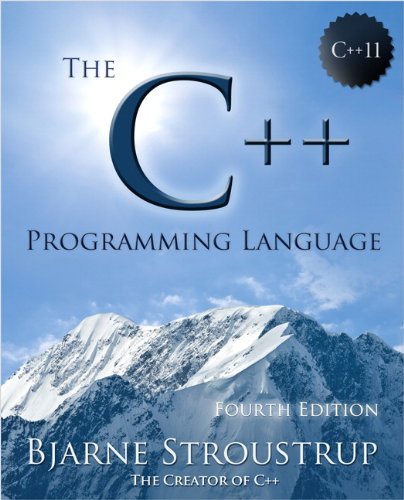
The C++ Programming Language Fourth Edition is now shipping

My book The C++ Programming Language (Fourth Edition) is now shipping.

I got my copy (the very first copy!) on Friday. At 9am Monday, it became available on the publisher’s site, InformIT, and at 10am it had sold out. This is all very scary for an author. I have worked hard on this for about four years (not counting the 13 years it took getting the C++11 standard out), but of course a 1360-page book is huge, so I’ll find flaws. Anyway, that’s my problem.

For a description of the book, see http://www.stroustrup.com/4th.html. In particular, read the preface and the back-cover text to see if this book might be of interest to you. It aims to be the most comprehensive description of the C++ language, standard library, and the programming techniques C++ is designed to support. It is not meant to be the quickest introduction to C++11 or a first introduction to programming. My TC++PL4 web page also has an extended table of contents, the Tour of C++, and the exercises.

As ever, comments (preferably polite and constructive) and bug reports are most welcome.