CLion 2025.3 Is Here, and It’s Epic: Constexpr Debugger, and More -- Oleg Zinovyev

CLion 2025.3 is here, a landmark release with a groundbreaking Constexpr Debugger...

CLion 2025.3 Is Here, and It’s Epic: FScreenshot_2025-12-09_170708.pngaster Language Engine, Unique Constexpr Debugger, DAP Support, and Much More

by Oleg Zinovyev

From the article:

CLion 2025.3 represents one of our most ambitious releases yet. Beyond the extensive feature additions and workflow improvements, this version marks a fundamental shift in how we approach C and C++ language support – prioritizing speed and precision at every level.

The key release updates are as follows:

Faster performance with the CLion Nova language engine as the default.
Deeper insight into compile-time evaluations with the unique Constexpr Debugger.
Expanded debugger options with support for the Debug Adapter Protocol.
[...]

Trip report: Meeting C++ 2025 -- Sandor Dargo

cippi-me-meeting-cpp2025.JPGWhat a year I had! One more conference, one more trip report! I had the chance to go to Meeting C++ and give not just one but two talks!

Trip report: Meeting C++ 2025

by Sandor Dargo

From the article:

I remember that last year I said that Berlin in November is the perfect place to have a conference because you want to be inside that four-star hotel and not outside. This year, the conference was held a week earlier, and the weather was so nice that it was actually tempting to go out and explore.

But people resisted the temptation. The lineup and content were very strong — this year there were more than 50 talks across 5 different tracks. Also, Meeting C++ is a fully hybrid conference, so you can join any talk online as well.

It might sound funny, but I must mention that the food is just great at Meeting C++. It’s probably the conference with the best catering I’ve ever been to — from lunch to coffee breaks, everything was top-notch.

This year, there were no evening programs. I’m not complaining; it’s both a pity and a blessing, and I’m not sure how I feel about it. For example, when I first attended C++ On Sea, there were no evening events, and I really enjoyed discovering Folkestone in the evenings. Over the years, the schedule there got extended, and sometimes I had no time to visit my favorite places. But at least some socializing was guaranteed. One can say that you can do it on your own, but many of us are introverted, and if we’re not forced to socialize, we just won’t. That’s even easier to avoid in a big city like Berlin. I remember that last year I didn’t have time to go out until the end of the conference. It was different this year.

But let’s talk about the talks.

My three favourite talks

Let me share with you the three talks I liked the most. They are listed in chronological order...


C++ Enum Class and Error Codes -- Mathieu Ropert

Me.jpgC++11 gave us enum class and while it’s great to have scoped enums I don’t find it great for error handling. Let’s talk about why.

C++ Enum Class and Error Codes

by Mathieu Ropert

From the article:

Most of my readers, I hope, have been able to use C++11 for a while now (if not hello, I’m sorry the world has changed to become this weird during your 14 years sleep). With it came a small change that allowed for better scoping of names without resorting to weird quirks: enum class. The idea is simple: owing to C, enum values in C++ belong to the class or namespace they are declared in but if we add the class keyword to the declaration they know become their own scope instead of leaking to their parent.

This was a simple quality of life change in the compiler to address a weakness in the language that folks usually worked around by either adding long prefix to the enum values (C style) or wrapping them within structs or classes (C++98/03 style). And with it came the incentive to migrate C era error code enums to scoped enums. But there’s a catch.


Trip report: Budapest C++ - Breaking & Building C++ -- Sandor Dargo

c++meetup_1022.jpegThe Budapest C++ Meetup was a great reminder of how strong and curious our local community is. Each talk approached the language from a different angle — Jonathan Müller from the perspective of performance, mine from design and type safety, and Marcell Juhász from security — yet all shared the same core message: understand what C++ gives you and use it wisely.

Trip report: Budapest C++ - Breaking & Building C++

by Sandor Dargo

From the article:

More than a hundred people registered, and the room quickly filled up with local developers eager to hear three technical talks. The atmosphere was lively and welcoming — it showed the strength of the C++ community in Budapest. In 2027, even WG21 might come to Hungary!

The evening began with Jonathan Müller’s talk, Cache-Friendly C++, followed by my own session on Strongly Typed Containers. Finally, Marcell Juhász closed the event with an insightful and hands-on presentation on Hacking and Securing C++.

Speeding up C++ functions with a thread_local cache -- Daniel Lemire

9af1530f-1aca-4fbc-8796-ff74a1a8b544-784x510.jpgWhen working with legacy or rigid codebases, performance bottlenecks can emerge from designs you can’t easily change—like interfaces that force inefficient map access by index. This article explores how a simple thread_local cache can dramatically improve performance in such cases, reducing repeated lookups from quadratic to near-constant time.

Speeding up C++ functions with a thread_local cache

by Daniel Lemire

From the article:

In large code bases, we are often stuck with unpleasant designs that are harming our performance. We might be looking for a non-intrusive method to improve the performance. For example, you may not want to change the function signatures.

Let us consider a concrete example. Maybe someone designed the programming interface so that you have to access the values from a map using an index. 


Using RAII to remedy defect where not all code paths performed required exit actions -- Raymond Chen

RaymondChen_5in-150x150.jpgA missing DismissUI() call on one code path led to a subtle bug—but rather than patching it with more try/catch and return logic, there’s a cleaner C++ solution. This article shows how to use RAII and wil::scope_exit to guarantee cleanup across all code paths, even in asynchronous callbacks.

Using RAII to remedy a defect where not all code paths performed required exit actions

by Raymond Chen

From the article:

A team asked me to review their pull request that fixed a bug that was caused by failing to perform some required action along all code paths. Here’s a simplified sketch:

void MySpecialFeature::OnButtonClick()
{
    try {
        auto file = PickFile();
        if (!file) {
            DismissUI();
            return;
        }

        if (ConfirmAction()) {
            if (m_useAlgorithm1) {
                // StartAlgorithm1 invokes the lambda when finished.
                StartAlgorithm1(file, [self = shared_from_this()] {
                    self->DismissUI();
                });
            } else {
                RunAlgorithm2(file);
                DismissUI();
            }
        } else { // this block was missing
           DismissUI(); 
        } 
    } catch (...) {
        DismissUI();
    }
}

Open wide: Inspecting LLVM 21 with static analysis

It has been over a year since the last check of the LLVM project with PVS-Studio, and in that time, two releases have come out. So, it's a good time to get back and analyze the fresh LLVM 21.

Open wide: Inspecting LLVM 21 with static analysis

by Nikita Terentev

From the article:

As we can see, error logging will never be executed, and, moreover, execution will always continue with potentially incorrect behavior. Here's what git blame reports: the code celebrates its tenth anniversary in November. One might think its meaning had changed over time. But no, history confirms that Defs has always been DenseMap, and its count function only returned 0 or 1 back then. If we search for other similar checks, we see that the count result is used as a binary value everywhere.


How to Iterate through std::tuple: C++26 Packs and Expansion Statements -- Bartlomiej Filipek

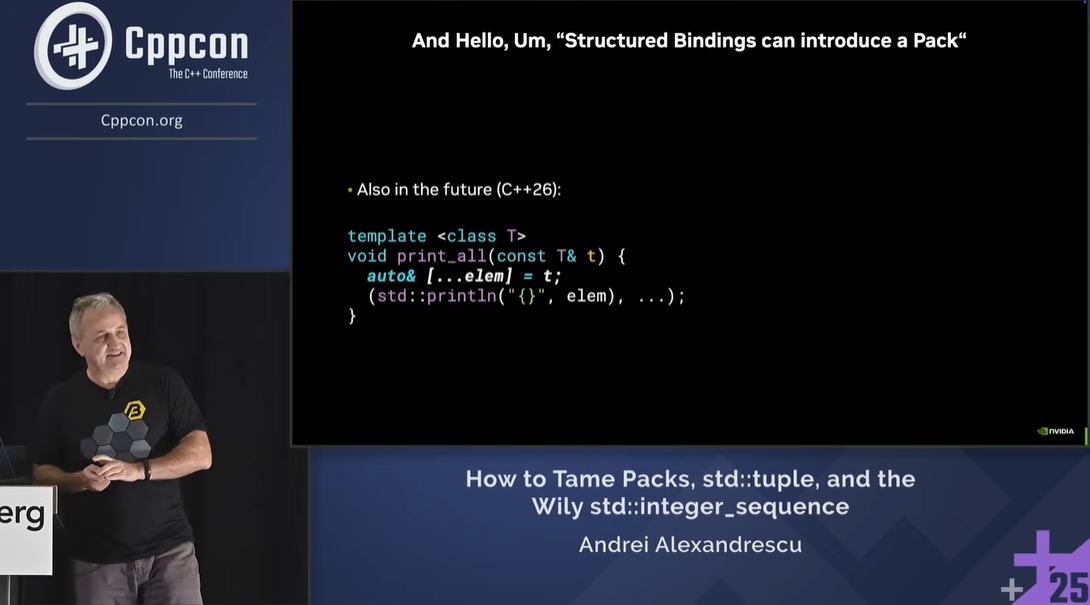
filipek-howtoiterate.pngIn this final part of the tuple-iteration mini-series, we move beyond C++20 and C++23 techniques to explore how C++26 finally brings first-class language support for compile-time iteration. With structured binding packs (P1061) and expansion statements (P1306), what once required clever template tricks can now be written in clean, expressive, modern C++.

C++ Templates: How to Iterate through std::tuple: C++26 Packs and Expansion Statements

by Bartlomiej Filipek

From the article:

In part 1 of this mini-series, we looked at the basics of iterating over a std::tuple using index_sequence and fold expressions. In part 2, we simplified things with std::apply and even created helpers like for_each_tuple and transform_tuple.

So far, we used C++ features up to C++20/23… but now, in C++26, we finally get language-level tools that make tuple iteration straightforward and expressive. In this article, we’ll explore two new techniques:

  • Structured bindings can introduce a pack - P1061 - turn a tuple into a pack of variables.
  • Expansion statements P1306 - the ultimate “compile-time loop” syntax.


Concept-Based Generic Programming -- Bjarne Stroustrup

A new paper:

Bjarne Stroustrup: Concept-Based Generic Programming

https://www.stroustrup.com/Concept-based-GP.pdf

We present programming techniques to illustrate the facilities and principles of C++ generic programming using concepts. Concepts are C++’s way to express constraints on generic code. As an initial example, we provide a simple type system that eliminates narrowing conversions and provides range checking without unnecessary notational or run-time overhead.