
CppCon 2025 Cache-Friendly C++ -- Jonathan Müller
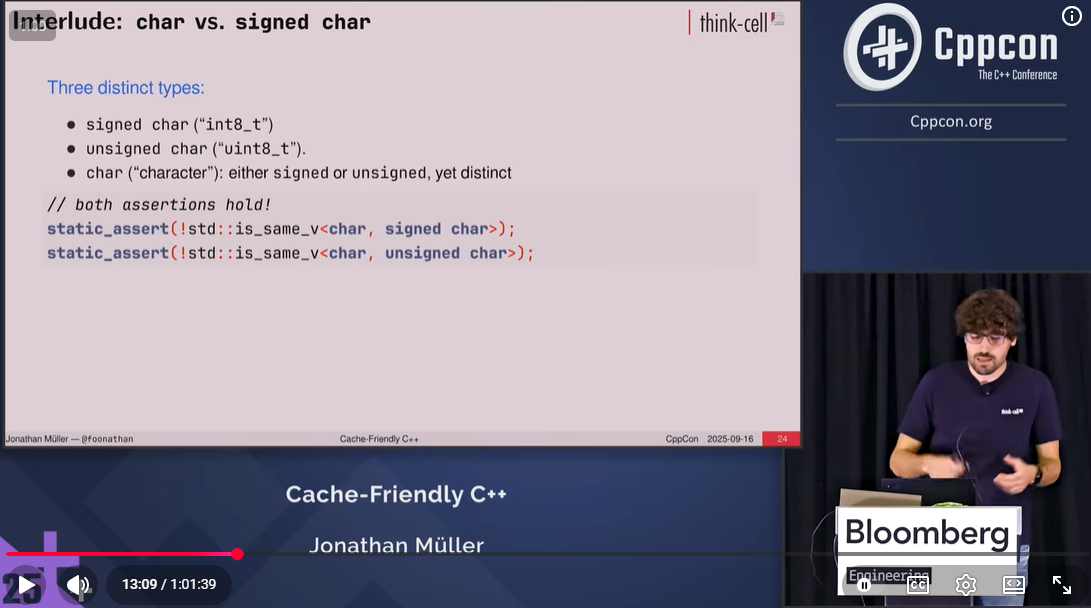 Registration is now open for CppCon 2026! The conference starts on September 12 and will be held in person in Aurora, CO. To whet your appetite for this year’s conference, we’re posting videos of some of the top-rated talks from last year's conference. Here’s another CppCon talk video we hope you will enjoy – and why not register today for CppCon 2026!
Cache-Friendly C++
by Jonathan Müller
Summary of the talk:
When you need a container, pick std::vector<T> by default. This is because std::vector<T> is cache-friendly.
What does that mean, though?
This talk will answer that from the ground-up. We will cover the need for CPU caches and their consequences, how the CPU tricks to make them as seamless as possible, and when and why those tricks sometimes fail. This means that you need to be careful when structuring your program to avoid slowdowns. We will thus explore cache-friendly data structures, data-oriented design, and how to avoid common pitfalls.
 Registration is now open for CppCon 2026! The conference starts on September 12 and will be held
  Registration is now open for CppCon 2026! The conference starts on September 12 and will be held
 Registration is now open for CppCon 2026! The conference starts on September 12 and will be held
  Registration is now open for CppCon 2026! The conference starts on September 12 and will be held
  Structured bindings in conditions may look like a small syntax sugar, but they let us write much more expressive conditional logic. By allowing decomposition and condition checking to live side by side, C++26 reduces boilerplate, improves locality, and better supports modern result types that bundle status and data together. This is a pragmatic, well-integrated evolution of a feature that has already proven its value since C++17.
