community

3 Test events for Meeting C++ 2021

In August, Meeting C++ online will host 3 test events on 3 different online platforms to test which one should be chosen to host Meeting C++ 2021.

Testing online platforms for Meeting C++ 2021

by Jens Weller

From the article:

For this year, the conference of Meeting C++ is online only. I've made this decision last year, when it was clear that this is an option that is available. With predictions of a 4th Wave in Europe in Fall, it seems to be the right decision. Since 2020 Meeting C++ online gathered a community of folks interested in C++ and attending online events into a User Group. With one year of experience in hosting online events, its time to move forward and see which platform should host these events in the future.

5th August: Teaching C++ with Victor Ciura
12th August: Ivan Cukic - Members through a looking glass!
19th August: Peter Sommerlad - Beyond rule of zero

Join the review and voting session for Meeting C++ 2021

Until next week Tuesday you can start your voting session and give feedback on the talks for Meeting C++ 2021.

Starting the review and feedback session for Meeting C++ 2021

by Jens Weller

From the article:

Like every year, Meeting C++ gives the C++ community the chance to review the talks and give feedback on them for a short period. You'll be able to leave a comment on each talk and vote between 0 - 5, where 5 is best.

C++ is awesome, here's why...--Vinit Jogani

What do you think?

C++ is awesome, here's why...

by Vinit Jogani

From the article:

C++ is, hands down, one of the most misunderstood languages in software developer pop culture today. People often compare it to C because it is a "low-level" language. Consequently, it has received a reputation of being an esoteric language that only the performance paranoid care about. This is far from true. I have been programming in C++ as my primary language for a while now and the developer experience is actually really good -- much better than I had imagined it would be.

In this article, I want to debunk some common myths about C++ that I heard before I started using it. Then, I want to talk about the actual superpowers that C++ provides you that most other languages do not...

CppCon 2020 Practical Memory Pool Based Allocators For Modern C++--Misha Shalem

Registration is now open for CppCon 2021, which starts on October 24 and will be held both in person and online. To whet your appetite for this year’s conference, we’re posting videos of some of the top-rated talks from our most recent in-person conference in 2019 and our online conference in 2020. Here’s another CppCon talk video we hope you will enjoy – and why not register today for CppCon 2021 to attend in person, online, or both!
Practical Memory Pool Based Allocators For Modern C++

by Misha Shalem

Summary of the talk:

Runtime-deterministic memory allocations are a crucial aspect of any safety-critical real-time system. One of the simplest and widely adopted allocation mechanisms used in such systems is a memory pool with fixed block sizes. Unfortunately, the need to know the exact sizes of the memory blocks makes any practical usage of memory pools with standard C++ allocator-based approach rather problematic since users often “hide” real properties of allocations which are made under the hood. For example: STL’s node-based containers like 'std::map' as well as other standard mechanisms like 'std::promise' or 'std::allocate_shared'.

Being a company which focuses on real-time safety-critical applications, we still see a significant value in keeping compatibility with the standard allocator model as well as in following common conventions which are familiar to every C++ developer.

This talk presents an approach which uses a combination of a memory allocator implementation which instruments the code, and an external LLVM-based tool which extracts the instrumentation information and generates static memory pool definitions, allowing the allocator to switch from the heap to a memory pool without any further changes to the code. The presentation will walk through a simplest possible implementation of this approach.

Software Architecture with C++, Book Review--Bartlomiej Filipek

Will you read it?

Software Architecture with C++, Book Review

by Bartlomiej Filipek

From the article:

In April, we got a new book - from two Polish authors - Piotr and Adrian - on C++ Software Architecture. This one is fascinating and refreshing. While it won’t teach you all the latest C++ features or low-level tricks in our favorite language, it will move you to a higher level with architecture, building, patterns, design, and development for the cloud.

Let’s see what’s inside.

CppCon 2019 How to Herd 1,000 Libraries--Robert Schumacher

Registration is now open for CppCon 2021, which starts on October 24 and will be held both in person and online. To whet your appetite for this year’s conference, we’re posting videos of some of the top-rated talks from our most recent in-person conference in 2019 and our online conference in 2020. Here’s another CppCon talk video we hope you will enjoy – and why not register today for CppCon 2021 to attend in person, online, or both!
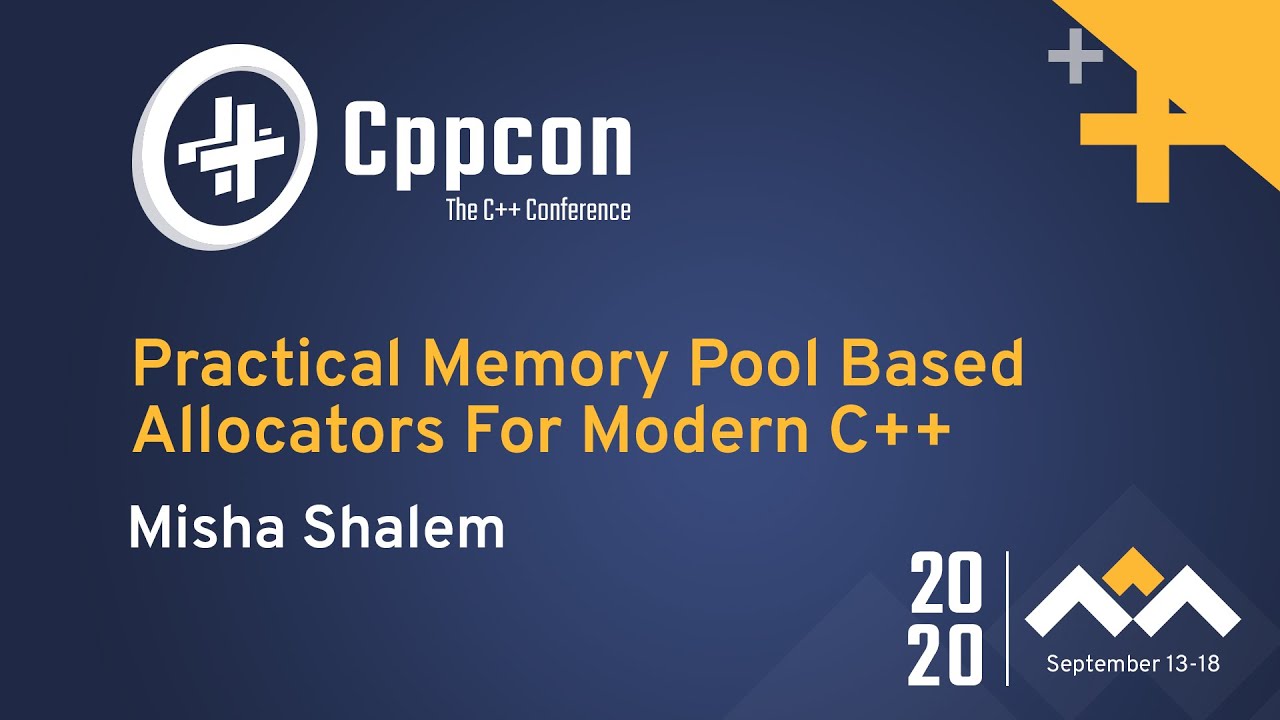
How to Herd 1,000 Libraries

by Robert Schumacher

Summary of the talk:

In the current C++ world, it is a struggle to convince even a single external library to build and behave. Adding a third and fourth dependency causes quadratic grief as each library interacts with each other and One Definition Rule violations lurk around every corner.

How, then, is it possible to manage over 1,000?

In this talk, we'll talk about the techniques, shims, and hacks used in the Vcpkg package manager to persuade, connive, and coerce all these independent moving parts into a single robust ecosystem. We'll sample the myriad approaches used by real-world libraries to declare dependence and walk through how they can be guided to do the right thing at the end of the day.

Private package management systems still thrive in corporations and these approaches can provide method to the madness of consuming open source.

C++ Trainings aligned with Meeting C++ 2021

These trainings will go along with a talk at Meeting C++ 2021:

C++ Trainings at Meeting C++ 2021

by Jens Weller

From the article:

Today I can give you a first overview on the planned trainings that accompany Meeting C++ 2021. All trainings are held online, the date is chosen by the trainers.

This years Meeting C++ conference focuses on learning and giving you the best experience online. Meeting C++ has chosen some of the best trainers to give you an opportunity to learn even more about C++ in 2021. Rainer Grimm, Patricia Aas and Slobodan Dmitrovic are the trainers for the first 3 fantastic courses.

CppCon 2020 Breaking Dependencies: The SOLID Principles--Klaus Iglberger

Registration is now open for CppCon 2021, which starts on October 24 and will be held both in person and online. To whet your appetite for this year’s conference, we’re posting videos of some of the top-rated talks from our most recent in-person conference in 2019 and our online conference in 2020. Here’s another CppCon talk video we hope you will enjoy – and why not register today for CppCon 2021 to attend in person, online, or both!

Breaking Dependencies: The SOLID Principles

by Klaus Iglberger

Summary of the talk:

SOLID is an abbreviation for five of the most important software design principles:
- (S)ingle Responsibility Principle
- (O)pen-Closed Principle
- (L)iskov Substitution Principle
- (I)nterface Segregation Principle
- (D)ependency Inversion Principle

For almost two decades, these principles have proven to be a valuable set of guidelines to cope with software dependencies. Although initially introduced as guidelines for object-oriented programming, they have become a universal set of guidelines that can be used equally well for procedural, functional or generic programming. In this talk I'll recap the SOLID principles and explain why they form such a valuable set of universal design guidelines. Also, I'll go into detail about several common misconceptions.

CppCon 2019 Reducing Template Compilation Overhead, Using C++11, 14, 17, and 20--Jorg Brown

Registration is now open for CppCon 2021, which starts on October 24 and will be held both in person and online. To whet your appetite for this year’s conference, we’re posting videos of some of the top-rated talks from our most recent in-person conference in 2019 and our online conference in 2020. Here’s another CppCon talk video we hope you will enjoy – and why not register today for CppCon 2021 to attend in person, online, or both!

Reducing Template Compilation Overhead, Using C++11, 14, 17, and 20

by Jorg Brown

Summary of the talk:

At their best, new C++ standards offer simpler, clearer, and faster-to-compile ways to write your code. But many information sources, for example Andrei Alexandrescu’s Modern C++ Design, haven’t been updated.

More importantly, template metaprogramming is not something we generally seek to optimize because a good compiler handles it well, and problems generally only show up in the form of long compile times.

In this presentation, I'll describe techniques you can use to simplify, clarify, and improve the compile speed, of your code, including:
* Using C++17 "if constexpr"
* Using C++11 variadic function / template arguments (often without needing recursion!)
* Using decltype on auto-return functions in order to compute types in a more readable way.
* Using C++20 constraints rather than std::enable_if