News

Expression Templates -- Volker Krause

volker-krause.jpgFrom this month's KDE Akademy conference:

Expression Templates: How I Learned to Stop Worrying and Love Template Meta-Programming (30 min video) (slides)

by Volker Krause

The speaker's opening words should be enough to get you to set aside a half hour:

"I'm going to talk about template metaprogramming in general and expression templates in particular. And that's obviously something we use every day. <laughter> You laugh, but in half an hour you will see that we actually do..."


Abstract:

Contrary to common perception, expression templates are not bizarre meta-programming theory but something you are (possibly unknowingly) using every day. We'll see what they are good for, how they work and and what to do if they don't.

Originally invented by Todd Veldhuizen for the use in the math library Blitz++, expression templates are often seen as one of those esoteric applications of C++ template meta-programming that results in completely incomprehensible code that only Marc and Thiago understand at best, and that gives you compiler errors longer than an average discussion on the right display manager.

In this talk we will try to counter this (wrong) perception, by looking at why and how this (syntactically) indeed somewhat complex code results in very elegant API and often outperforms conventional implementations. On the way we will see that C++ template meta-programming code is actually not that scary, and that template-related compiler errors aren't that bad either.

Now why would this be of interest to the average Qt or KDE developer? Well, since the introduction of QStringBuilder in Qt 4.7 we have expression templates for a very common use case, string concatenations. And if your code is somewhere in KDE Git, it's very likely Laurent enabled the use of QStringBuilder for you already. So, we are not talking about exotic theory here, but about tools you are using every day.

Is Moving Objects Worth the Hassle? -- Andrew Koenig

Koenig's latest just went live at DDJ:

Is Moving Objects Worth the Hassle?

by Andrew Koenig

From the article:

Last week, I discussed how C++ compilers use overloading to decide whether to move or copy an object. This week, I'd like to take a step back and discuss why moving instead of copying is worth doing in the first place.

You might think that this claim needs no justification. After all, copying takes time; so programs that copy a lot of data will be slower than programs that avoid doing so. However, this kind of unthinking optimization can lead to trouble. For example...

The Universal Reference/Overloading Collision Conundrum -- Scott Meyers

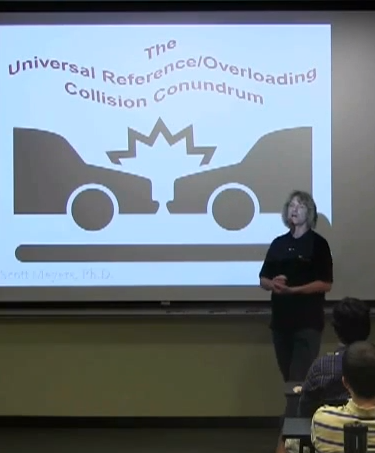
meyers-nwcpp-13.PNG[Blog suggestion by NoSenseEtAl. Text below added by editor.]

Scott Meyers gave a well-received "beta" talk last week at NWCPP on the topic below, which he described as the most complex Item he's encountered as he prepares his upcoming book Effective C++11/14:

The Universal Reference/Overloading Collision Conundrum

by Scott Meyers

Abstract:

To help address the confusion that arises when rvalue references become lvalue references through reference collapsing, Scott Meyers introduced the notion of "universal references." In this presentation, he builds on this foundation by explaining that overloading functions on rvalue references is sensible and useful, while seemingly similar overloading on universal references yields confusing, unhelpful behavior. But what do you do when you want to write a perfect forwarding function (which requires universal references), yet you want to customize its behavior for certain types? If overloading is off the table, what's on? In this talk, Scott surveys a variety of options.

Though Scott will give a one-slide overview of the idea behind universal references at the beginning of the presentation, attendees are encouraged to familiarize themselves with the notion in more detail prior to the talk. Links to written and video introductions to universal references are available here.

The Point of No Return -- bulldozer00

A cute nugget about [[noreturn]]:

The Point of No Return

by bulldozer00

As part of learning the new feature set in C++11, I stumbled upon the weird syntax for the new “attribute” feature: [[ ]]. One of these new C++11 attributes is [[noreturn]]. ...

C++'s Best Feature -- Andrzej Krzemieński

Andrzej's title is not only catchy, but completely correct (we politely disagree with your final disclaimer, sorry Andrzej): Deterministic lifetime with destructors is C++'s best feature, and very underappreciated. Like most wonderful things, you appreciate it most when it's gone, namely when you're using another language where it's absent.

C++'s best feature

by Andrzej Krzemieński

From the article:

C++, if you want to learn all of it, is big, difficult and tricky. If you look at what some people do with it, you might get scared. New features are being added. It takes years to learn every corner of the language.

But you do not need to learn all of it. Effective use of C++ requires only the knowledge of a couple of its essential features. In this post, I am going to write about one C++ feature that I consider one of the most important. The one that makes me choose C++ rather than other popular programming languages. ...

Sometimes You Must Violate an Abstraction to Maintain It -- Andrew Koenig

Koenig explains std::move as, well, just a bit of a fib, really:

Sometimes You Must Violate an Abstraction to Maintain It

by Andrew Koenig

From the article:

What std::move really does is to return its argument as an rvalue reference. In effect, every time we use std::move, we are telling a lie. In this case, by writing std::move(t.s), we are saying that we want to use t.s, but to do so in a way that treats t.s as an rvalue. It is acceptable for us to tell this lie for exactly the same reason that it is acceptable for us to cast t.s to string&& in the previous example: We know that t.s is a member of t, and t really refers to an rvalue in our caller's context.

We can tell such lies any time we are willing to take responsibility for the consequences. ...

C++11/14 Training Materials -- Scott Meyers

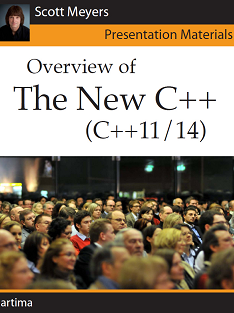
meyers-newcppmaterials.PNGC++14 is still very much a draft -- it only became feature-complete in April and is now in its primary comment ballot. But interest in this new standard is high, with a restarted "Guru of the Week" series focusing on C++14 and now Scott Meyers has produced the first book-like materials that include significant coverage of C++14.

C++11 Training Materials Updated -- Now With C++14 Info!

For the seventh time since originally releasing them over three years ago, I've updated my annotated training materials for "The New C++". Until this update, "the new C++" referred to C++11, but with this revision, I'm including treatment of several features from draft C++14 that I believe will make it into the new new standard. As far as I know, this makes my training materials the first "book-like" publication that covers features in C++14.