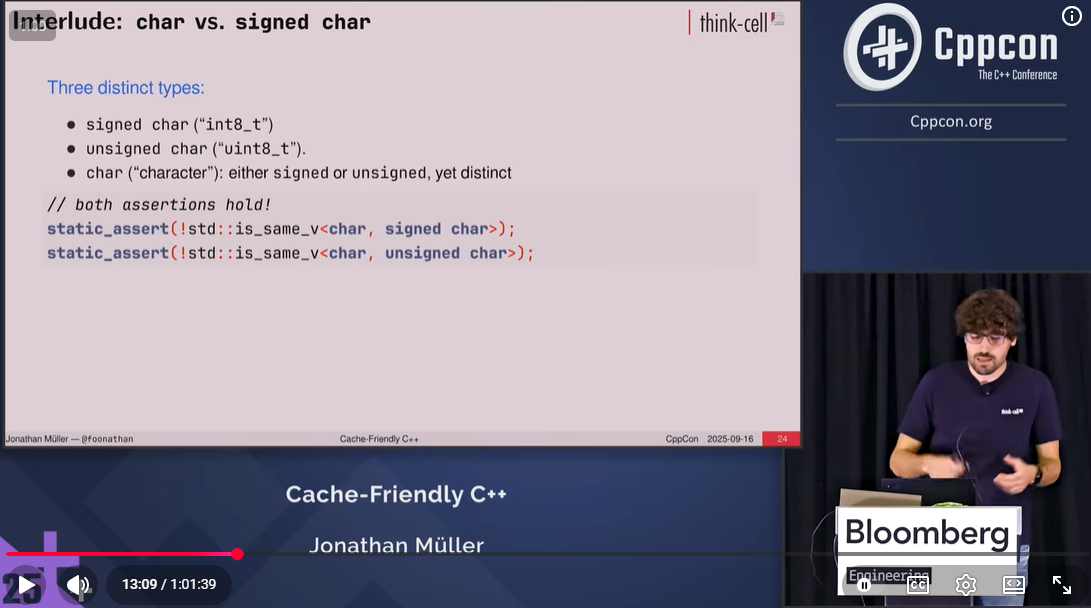
CppCon 2025 Back to Basics: Custom Allocators Explained - From Basics to Advanced -- Kevin Carpenter

Custom_Allocators_carpenter.pngRegistration is now open for CppCon 2026! The conference starts on September 12 and will be held in person in Aurora, CO. To whet your appetite for this year’s conference, we’re posting videos of some of the top-rated talks from last year's conference. Here’s another CppCon talk video we hope you will enjoy – and why not register today for CppCon 2026!
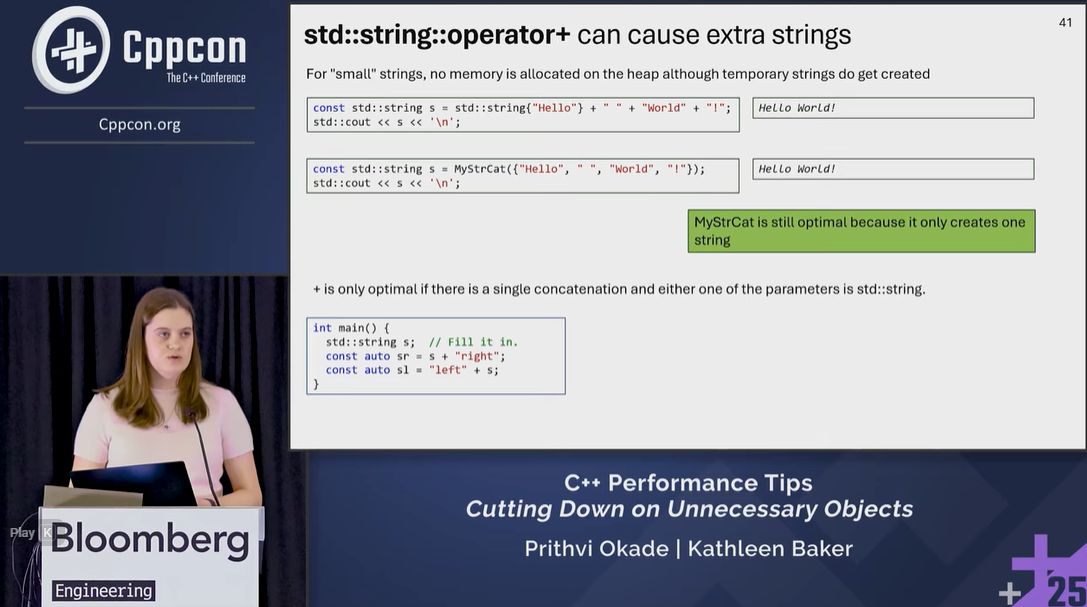
Back to Basics: Custom Allocators Explained - From Basics to Advanced

by Kevin Carpenter

Summary of the talk:

Effective memory management is crucial for building efficient and reliable C++ applications. Custom memory allocators provide a powerful tool for optimizing memory usage, reducing fragmentation, and improving performance. This talk will explore the intricacies of memory allocation in C++, from the basics of dynamic memory management to the implementation of custom allocators. Attendees will gain insights into the standard allocator model, techniques for designing custom allocators, and practical examples of their use in real-world applications.

Join us to unlock the full potential of memory management in your C++ projects.

using std::cpp 2026: Learning C++ as a newcomer - Berill Farkas

What does a 15 years old girl think about learning C++?

Summary of the talk:

How it feels like to learn C++ as a teenager? What made her want to learn it and what difficulties did she come across while learning it?


CppCon 2025 Cache Me Maybe: The Performance Secret Every C++ Developer Needs -- Michelle D'Souza

Cache_Me_Maybe_dsouza.pngRegistration is now open for CppCon 2026! The conference starts on September 12 and will be held in person in Aurora, CO. To whet your appetite for this year’s conference, we’re posting videos of some of the top-rated talks from last year's conference. Here’s another CppCon talk video we hope you will enjoy – and why not register today for CppCon 2026!
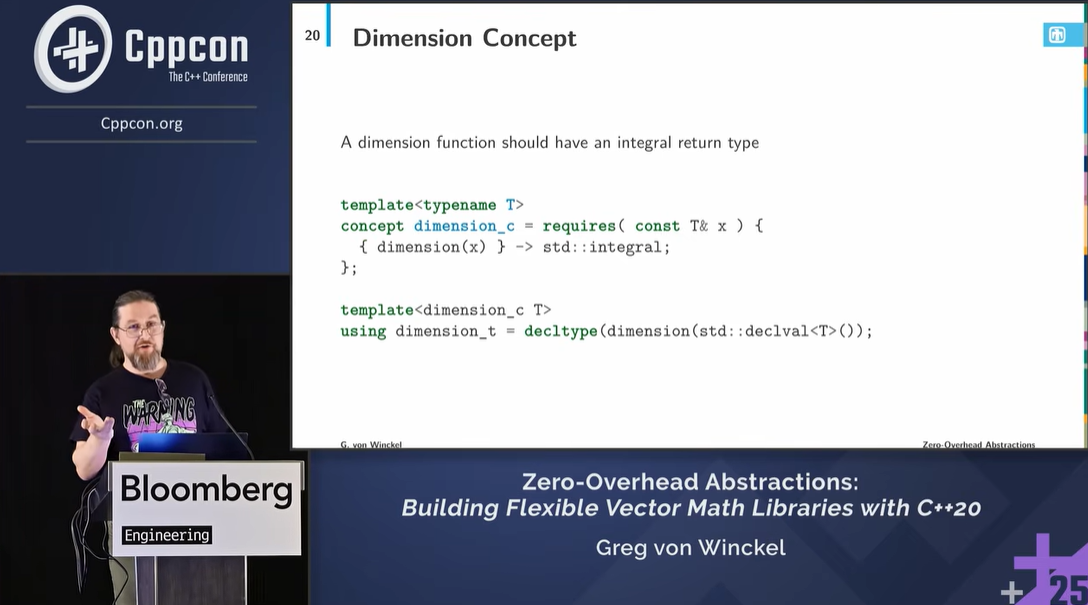
Cache Me Maybe: The Performance Secret Every C++ Developer Needs

by Michelle D'Souza

Summary of the talk:

Calling all code detectives! Grab your trench coats and magnifying glasses ... it's time to crack the case of sluggish C++ performance. In this thrilling investigation, we'll uncover the hidden world of your computer's built-in cache and how to harness it to turbocharge your code.

We'll comb through the fundamentals of caches like seasoned sleuths, uncover clues on optimizing access patterns, and interrogate suspects like false sharing and cache unfriendly data structures. We will also examine benchmark evidence based on real-world production code, exposing how each technique delivers the goods.

By the end of this mission, you'll be armed with a detective's toolkit of cache savvy strategies, ready to solve cross-platform performance mysteries and bring blazing fast code to justice. Cache you at this session, maybe!

std::vector — Four Mechanisms Behind Every push_back() -- Gracjan Olbinski

A walkthrough of four mechanisms working behind every push_back() call — exponential growth and amortized O(1), the growth factor's effect on memory reuse, cache performance from contiguity, and the silent noexcept trap in move semantics during reallocation.

std::vector — Four Mechanisms Behind Every push_back()

by Gracjan Olbinski

From the article:

"You call push_back() a thousand times. The vector reallocates about ten. Behind that simple interface, four mechanisms are working together — each one invisible during normal use, each one shaping your performance in ways that push_back() will never tell you about."


CppCon 25 Matrix Multiplication Deep Dive || Cache Blocking, SIMD & Parallelization -- Aliaksei Sala

matrix_multiplication_Aliaksei_Sala.pngRegistration is now open for CppCon 2026! The conference starts on September 12 and will be held in person in Aurora, CO. To whet your appetite for this year’s conference, we’re posting videos of some of the top-rated talks from last year's conference. Here’s another CppCon talk video we hope you will enjoy – and why not register today for CppCon 2026!

Matrix Multiplication Deep Dive || Cache Blocking, SIMD & Parallelization

by Aliaksei Sala

Summary of the talk:

Matrix multiplication is a fundamental operation in scientific computing, game development, AI, and numerous high-performance applications. While its mathematical definition is simple, achieving optimal performance in C++ is far from trivial.

In this talk, we will explore different optimization techniques for matrix multiplication, from naive implementations to highly tuned versions leveraging modern hardware features. We will cover key performance-enhancing strategies such as loop unrolling, cache blocking, SIMD vectorization, parallelization using threads and more. Through benchmarking and profiling, we will measure the real impact of these optimizations.

By the end of this session, attendees will gain insights into two critical questions:

How hard is it to implement an optimized matrix multiplication in C++? How effective is C++ for achieving peak performance in this task?

This talk is suitable for developers interested in performance optimization, computational efficiency, and modern C++ techniques for numerical computing.

The hidden compile-time cost of C++26 reflection -- Vittorio Romeo

How much does C++26 Reflection actually cost your build?

In this article, we'll perform some early compilation time benchmarks of one of the most awaited C++26 features.

The hidden compile-time cost of C++26 reflection

by Vittorio Romeo

From the article:

Fast compilation times are extremely valuable to keep iteration times low, productivity and motivation high, and to quickly see the impact of your changes.

I would love to see a world where C++26 reflection is as close as possible to a lightweight language feature [...]

So, I decided to take some early measurements.

Stop Choosing: Get C++ Performance in Python Algos with C++26 -- Richard Hickling

merton-bot.pngIn algorithmic trading, the Python-vs-C++ debate is usually framed as flexibility versus speed — rapid strategy development on one side, ultra-low-latency execution on the other. But with C++26 reflection, that trade-off starts to disappear, making it possible to generate Python bindings automatically while keeping the core logic running at native C++ performance.

Stop Choosing: Get C++ Performance in Python Algos with C++26

by Richard Hickling

From the article:

The “religious war” between Python and C++ in algorithmic trading usually boils down to a single trade-off: Python is faster for getting ideas to market, while C++ is faster for getting orders into the book.

But why choose? With the advent of C++26 Reflection, you can now have the flexibility of a Python-based strategy without the performance penalty of slow loops.

Bring in C++ Rapidly: How Reflection Works

The biggest hurdle in hybrid trading systems has always been the “bridge.” Traditionally, if you wrote a complex pricer in C++, you had to manually write “boilerplate” code to tell Python how to talk to it. If you added a new function, you had to update the bridge. It was tedious and error-prone.

Reflection changes the game by allowing the code to “look in the mirror”. Instead of you manually describing your C++ functions to Python, the compiler does it for you. It programmatically inspects your classes and generates the bindings automatically.

CppCon 2025 Practical Reflection With C++26 -- Barry Revzin

practical_reflection_revzin.pngRegistration is now open for CppCon 2026! The conference starts on September 12 and will be held in person in Aurora, CO. To whet your appetite for this year’s conference, we’re posting videos of some of the top-rated talks from last year's conference. Here’s another CppCon talk video we hope you will enjoy – and why not register today for CppCon 2026!
Practical Reflection With C++26

by Barry Revzin

Summary of the talk:

With the adoption of Reflection for C++26, the landscape of what is possible has shifted. This talk will focus on implementing Struct-of-Arrays for an arbitrary aggregate, but will also take some detours to cover some techniques that will prove useful for solving a wide range of problems.

A Brief History of Bjarne Stroustrup, the Creator of C++ -- CultRepo

In this portrait, we meet Bjarne Stroustrup where we talk about his childhood, his accidental entry into computer science (what is "datologi" anyway?), and the ideas that shaped one of the most influential programming languages ever made -- among many, many other things... like how pronouncing his last name involves a potato.

A Brief History of Bjarne Stroustrup, the Creator of C++

by CultRepo

Watch now:

<iframe width="560" height="315" src="https://www.youtube.com/embed/uDtvEsv730Y?si=QD_WmemwpsAfNsVI" title="YouTube video player" frameborder="0" allow="accelerometer; autoplay; clipboard-write; encrypted-media; gyroscope; picture-in-picture; web-share" referrerpolicy="strict-origin-when-cross-origin" allowfullscreen></iframe>

Announcing Meeting C++ 2026

This years Meeting C++ conference is special, as its the 15th conference in total that Meeting C++ has organized, and its also the 5th time the event is hybrid!

Announcing Meeting C++ 2026

by Jens Weller

From the article:

We'll be meeting from the 26th - 28th November in Berlin! You have the unique chance to spend the 1st advent in Berlin with C++ and Christmas Markets open!

With Mateusz Pusz and Kate Gregory I've chosen two well known speakers for the keynotes this year. Mateusz is well known for his units library, which currently also is proposed for the standard. It is also an important contribution to making C++ more safe and secure, the big topic of last year. Then Kate Gregory will be visiting us in Berlin again, she is known for her ability to create great talks around technical and social aspects in our daily lives as devs. You might remember her from giving a keynote in 2017, or speaking about the aging programmer two years ago.

For the 15th time Meeting C++ will organize a great event for 3 days filled with lots of content about C++, like last year the plan is to host 3 tracks in parallel in Berlin, with an optional 4th track. The 4th track will be unlocked either by sponsorships or ticket sales. You can be a part of this great C++ event by attending onsite and online. There is already great news for onsite attendees: Hudson River Trading is again this years t-shirt sponsor, a great and unique Meeting C++ 2026 t-shirt is an exclusive perk for onsite attendees!