
BeCPP Symposium 2026 - Keith Stockdale - The journey to "/W4 /WX": How hard could it be?
BeCPP Symposium 2026 (organized by BeCPP): Now on YouTube!

Keith Stockdale - The journey to "/W4 /WX": How hard could it be?

Abstract:

Building on the recent work of improving the quality of Sea of Thieves' codebase by upgrading from C++14 to C++20, this talk will focus on the work that has went into enabling warnings as errors on the game, and more. Rare will discuss the motivations behind wanting to crank up the warning level, and to flick the "warnings as errors" switch after 10 years of development in their multi-million line Unreal Engine code base.

About the Speaker:

Keith is a Northern Irish senior software engineer who has been working on the Engine and Rendering teams at Rare Ltd for the last 9 years. He primarily works on Engine and Rendering level systems involving General Purpose GPU systems such as GPU particle systems. Keith is enthusiastic about promoting writing good quality code, whether it is running on the CPU on the GPU.
 

BeCPP Symposium 2026 - Chris Croft-White - Agentic Time-Travel Debugging

BeCPP Symposium 2026 (organized by BeCPP): Now on YouTube!

Chris Croft-White - Agentic Time-Travel Debugging

Abstract:

Time-travel debugging is a powerful technique to dive deep into the execution of your applications, providing visibility simply not available any other way and enabling rapid diagnosis of issues as well as understanding of unfamiliar code bases. With the AI revolution going on today, hallucinations are a major concern and limiting factor for adoption. Combining these two technologies enables us to give the AI Agent all the information it could possibly want about what happened in your application. This enables it to both investigate when something goes wrong to develop a hypothesis, but also a way to validate that hypothesis, and iterate on it as needed until the AI Agent is able to verifiably explain what happened and why.

About the Speaker:

Chris Croft-White is a Staff Solutions Architect at Undo, where he works at the intersection of debugging technology and developer productivity. With a career spanning field applications engineering, security, and technical pre-sales, he brings a practitioner's perspective to the challenge of helping engineering teams ship reliable software faster. Chris is currently focused on the emerging field of agentic debugging, exploring how AI can move beyond code generation to become a genuine partner in root cause analysis and defect resolution. He writes and speaks on practical approaches to integrating AI into real-world debugging workflows, cutting through the hype to find what actually works.


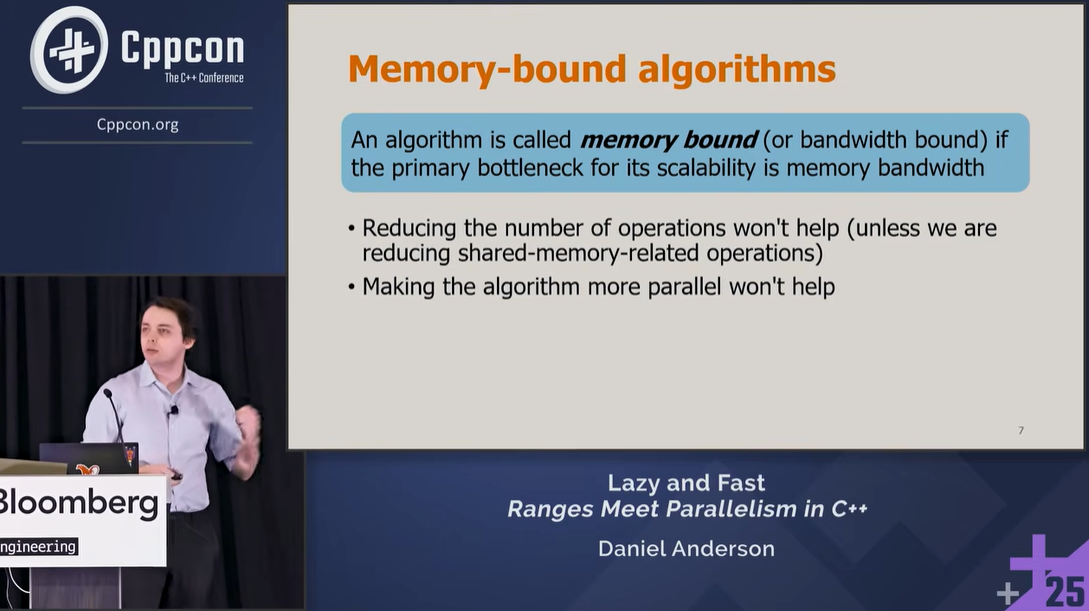
CppCon 2025 Lazy and Fast: Ranges Meet Parallelism in C++ -- Daniel Anderson

anderson-lazy.pngRegistration is now open for CppCon 2026! The conference starts on September 12 and will be held in person in Aurora, CO. To whet your appetite for this year’s conference, we’re posting videos of some of the top-rated talks from last year's conference. Here’s another CppCon talk video we hope you will enjoy – and why not register today for CppCon 2026!

Lazy and Fast: Ranges Meet Parallelism in C++

by Daniel Anderson

Summary of the talk:

Recent advances in the C++ standard have introduced powerful features like ranges and parallel algorithms—both aimed at writing faster, cleaner, and more expressive code. Ranges offer lazy, on-demand computation that improves I/O efficiency and composability. Parallel algorithms, on the other hand, harness multitasking to speed up compute-heavy workloads.

At first glance, these two features seem like a perfect match: lazy evaluation to minimize I/O overhead, and parallelism to maximize throughput. However, in practice, they don’t play well together. Many range operations—especially those over non-random-access sources—are inherently sequential due to their lazy pull-based, one-element-at-a-time nature.

In this talk, we’ll explore a modern library technique that unlocks the synergy between lazy ranges and parallelism. You’ll see how to build lazy, composable range pipelines that are parallel-friendly—capable of efficiently expressing operations like filter, scan, and flatten without sacrificing performance or elegance. We’ll walk through real-world examples where these techniques deliver strong parallel speedups with minimal programming overhead.

Whether you’re a library designer, performance enthusiast, or just curious about making your range-based code scale, this talk will equip you with practical tools to bridge the gap between composability and parallelism in modern C++.

C++26: string and string_view improvements -- Sandor Dargo

SANDOR_DARGO_ROUND.JPGLet’s continue our exploration of C++26 improvements. Today we focus on string_view. Some types got new constructors accepting string_views, and concatenation of strings and string_views just got easier.
C++26: string and string_view improvements

by Sandor Dargo

From the article:

But let’s start with a brief reminder of what a string_view is.

Reminder: the role of string_view

std::string_view was introduced in C++17 and its purpose is to provide read-only access to a string-like object. It can often replace const string& parameters and offers a significant performance gain. It’s generally advisable to use it whenever you’d pass an immutable string-like input that you cannot move from source to target.

We covered the topic earlier in more depth here.

P2495R3: Interfacing stringstreams with string_view

A stringstream is a good old tool for dealing with operations on string-based streams. While C++23 introduced spanstreams, due to fundamental semantic differences, stringstreams are not dead and it’s important to maintain them.

Being a good old tool also means they predate string_view. Given the available set of constructors, if you want to initialize a stringstream from a string_view, you first have to manually convert it into a string.

P2495R3 fixes this by adding new constructors accepting string_views.

It’s worth noting that this is a purely additive library change — it doesn’t break existing code.

At the moment of publication, this change is already available on Clang 19.

CppCon 2025 How to Tame Packs, std::tuple, & the Wily std::integer_sequence -- Andrei Alexandrescu

alexandrescu-tame.pngRegistration is now open for CppCon 2026! The conference starts on September 12 and will be held in person in Aurora, CO. To whet your appetite for this year’s conference, we’re posting videos of some of the top-rated talks from last year's conference. Here’s another CppCon talk video we hope you will enjoy – and why not register today for CppCon 2026!

How to Tame Packs, std::tuple, and the Wily std::integer_sequence

by Andrei Alexandrescu

Summary of the talk:

Template parameter packs and std::tuple unlock powerful metaprogramming capabilities in C++, but they also introduce a parallel sublanguage—one with unfamiliar rules, verbose idioms, and surprising limitations. Packs were originally designed for perfect forwarding, not compile-time iteration, which makes even simple tasks like filtering or transformation awkward. std::integer_sequence helps, but mostly by shifting the burden rather than removing it.

Existing library utilities offer some relief, but often feel inconsistent and difficult to compose. This talk explores why working with packs and tuples feels harder than it should, and demonstrates a small set of clean, reusable abstractions that make these tasks simpler, safer, and more expressive. Attendees will leave with practical tools—(and, with luck, a renewed hope) that structured metaprogramming in C++ doesn't have to be so hard.

New features in GCC 16: Improved error messages and SARIF output -- David Malcolm

redhatgraphic.pngGCC 16 is about to be released, so I'm sharing some of the new features I worked on this year. Some changes are visible to users, while others improve the system more subtly.
New features in GCC 16: Improved error messages and SARIF output

by David Malcolm

From the article:

A well-known challenge for C++ developers is the readability of template-related error messages. C++ compilers tend to either provide too little information or spew screenfuls of text at you. Either way, the errors can be difficult to decipher.

GCC error messages have a hierarchical structure to them. In GCC 15, I added an experimental option that shows this structure as a collection of nested bullet points.

In GCC 16, this behavior is now the default. You can return to the previous behavior using -fno-diagnostics-show-nesting or -fdiagnostics-plain-output. I fixed several bugs and made use of the hierarchical structure in more places. For example, it is easy to get declarations and definitions out of sync when manually adding const to a parameter:

class foo
{
  public:
    void test(int i, int j, void *ptr, int k);
};
    
// Wrong "const"-ness of param 3.
void foo::test(int i, int j, const void *ptr, int k)
{
}

Trip report: June 2026 ISO C++ standards meeting (Brno, Czechia) -- Herb Sutter

Hot off the press from the latest ISO C++ meeting:

Trip report: June 2026 ISO C++ standards meeting (Brno, Czechia)

by Herb Sutter

From the article:

tl;dr… A few highlights

  • Adopted this week in draft C++29: Complete catalog of all undefined behavior (UB) in C++. Contract pre/post support for virtual functions. Defaulting (=default) for postfix increment/decrement. Designated initializers for base classes. Python-style .lookup(key) for associative containers. And more…
  • Other significant progress: Progress on various features targeting C++29, including systematically addressing UB and adding safety profiles for C++.
  • Next six months: Telecon line-by-line review of a proposal to systematically address all undefined behavior in C++. Progress adding C++ memory safety subsetting profiles. Both aim for inclusion in C++29.

C++26: Structured Bindings can introduce a Pack -- Sandor Dargo

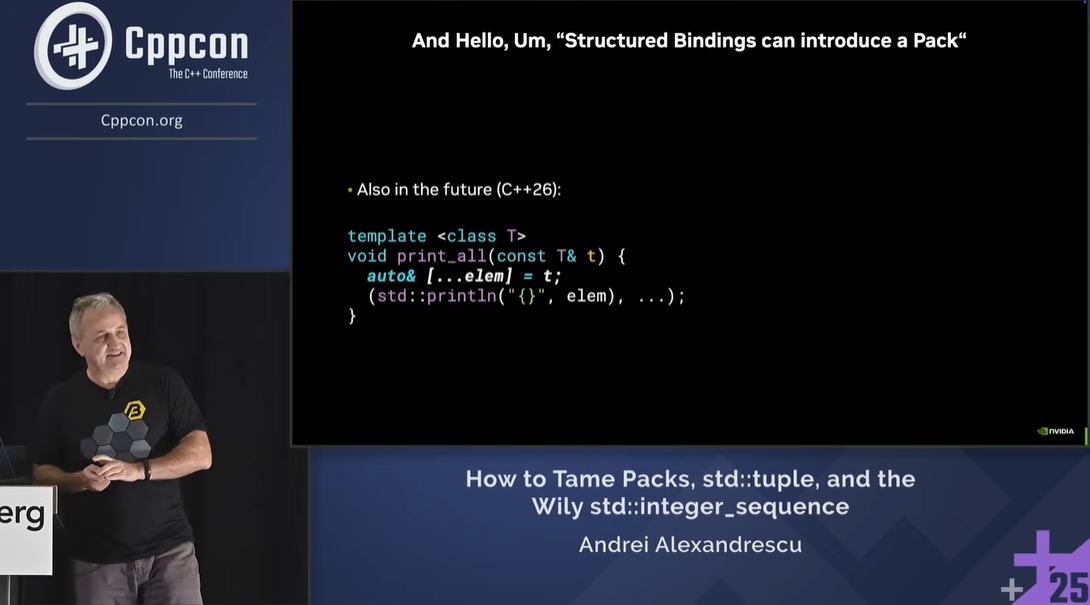
SANDOR_DARGO_ROUND.JPGIn previous posts, we talked about how C++26 improves structured bindings by allowing them to be used in conditionals’ init statements. We also briefly touched on other improvements coming in C++26, such as individual binding annotations and constexpr bindings. There is, however, one important enhancement to structured bindings that we haven’t covered yet on this blog: Structured Bindings can introduce a Pack

C++26: Structured Bindings can introduce a Pack

by Sandor Dargo

From the article:

Before diving into the feature itself, let’s briefly clarify what a pack is. A reasonably accurate (and not overly simplistic) definition is the following:

A parameter pack is a language construct that represents an arbitrary number of types or values, allowing code to accept and operate on an arbitrary number of arguments in a type-safe way.

I deliberately avoided using the word template in this definition. Historically, packs only existed in templated contexts, but that limitation is slowly being relaxed. Earlier versions of the proposal behind this feature even aimed to support structured binding packs in non-templated contexts. That part was eventually dropped due to implementation complexity and related objections — but the direction is still telling.

The voting on the talks for Meeting C++ 2026 has begun!

The yearly voting for the conference program of Meeting C++ has begun! You can vote on 118 talks until Sunday 21st.

The voting on the talks for Meeting C++ 2026 has begun!

by Jens Weller

From the article:

Once again its time for the C++ community to take a look at the submitted talks for Meeting C++ 2026! Thanks to all folks who have submitted a talk to this years conference! Your contribution will create another great conference in Berlin and online! And special thanks to all folks who have bought tickets already for the conference, you'll have a bit more weight in the voting to shape this years program! Same is true if you spoke at Meeting C++ in the past or attended last years conference.

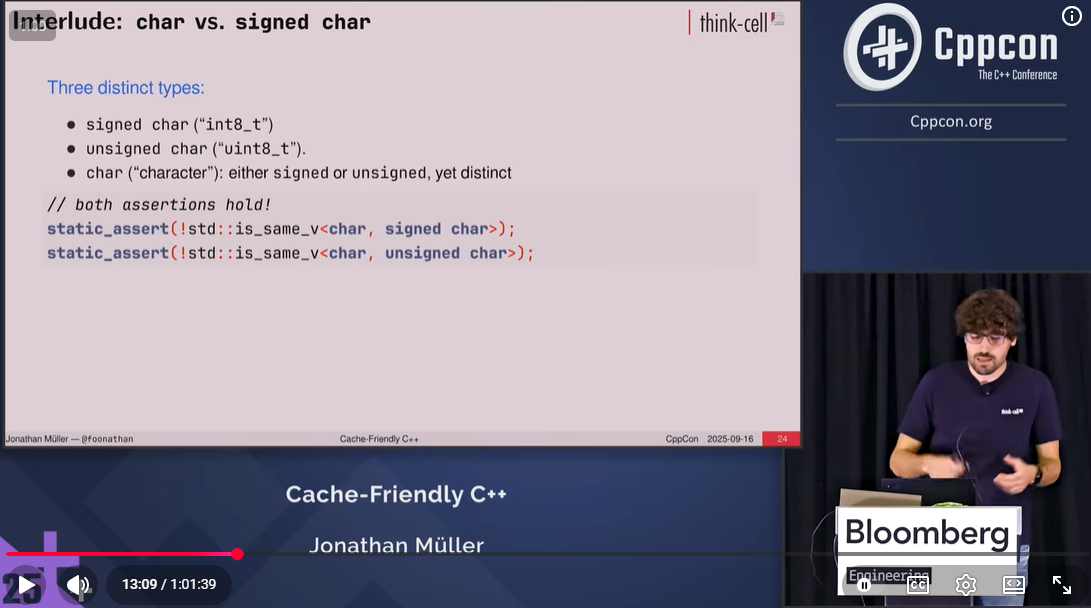
CppCon 2025 Cache-Friendly C++ -- Jonathan Müller

muller-cache.pngRegistration is now open for CppCon 2026! The conference starts on September 12 and will be held in person in Aurora, CO. To whet your appetite for this year’s conference, we’re posting videos of some of the top-rated talks from last year's conference. Here’s another CppCon talk video we hope you will enjoy – and why not register today for CppCon 2026!

Cache-Friendly C++

by Jonathan Müller

Summary of the talk:

When you need a container, pick std::vector<T> by default. This is because std::vector<T> is cache-friendly.

What does that mean, though?

This talk will answer that from the ground-up. We will cover the need for CPU caches and their consequences, how the CPU tricks to make them as seamless as possible, and when and why those tricks sometimes fail. This means that you need to be careful when structuring your program to avoid slowdowns. We will thus explore cache-friendly data structures, data-oriented design, and how to avoid common pitfalls.