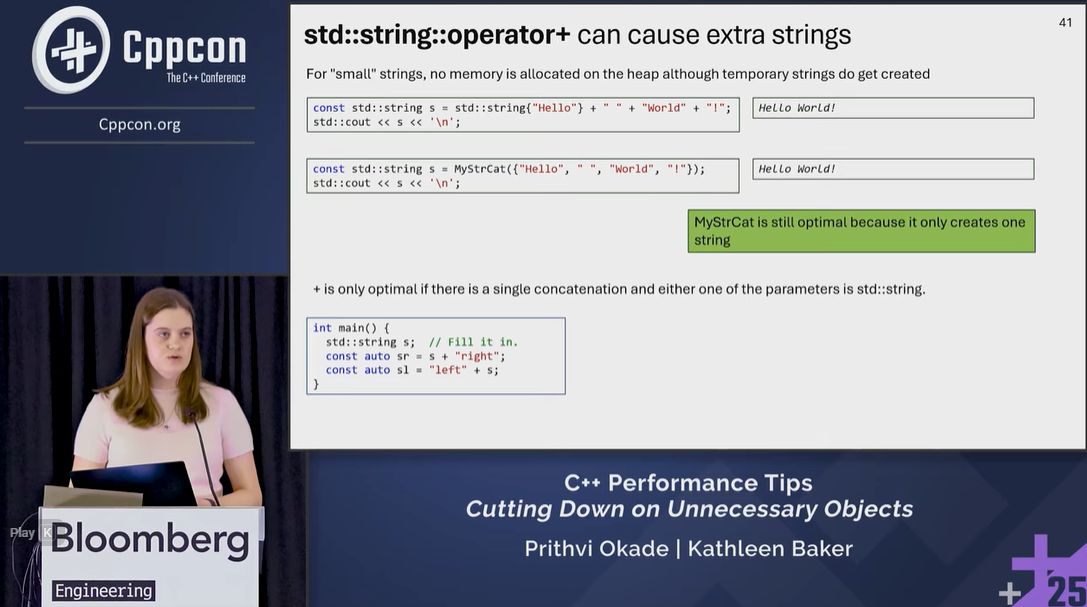
CppCon 2025 Cutting Down on Unnecessary Objects -- Prithvi Okade & Kathleen Baker
 Registration is now open for CppCon 2026! The conference starts on September 12 and will be held in person in Aurora, CO. To whet your appetite for this year’s conference, we’re posting videos of some of the top-rated talks from last year's conference. Here’s another CppCon talk video we hope you will enjoy – and why not register today for CppCon 2026!
C++ Performance Tips: Cutting Down on Unnecessary Objects
by Prithvi Okade & Kathleen Baker
Summary of the talk:
In C++, unnecessary temporary object creation can lead to costly runtime operations, increased code execution, and higher memory usage. Luckily this can be improved! This talk investigates common scenarios that result in the creation of temporary objects and how to detect these scenarios, demonstrated through code examples. We will then explore strategies to reduce the creation of such objects with techniques like explicitly moving objects, passing objects by reference, leveraging lightweight classes like std::string_view and std::span , using functions like reserve and emplace , and more. Join us to learn how to optimize your code’s performance and adopt better practices.
 Registration is now open for CppCon 2026! The conference starts on September 12 and will be held
 Registration is now open for CppCon 2026! The conference starts on September 12 and will be held
  Registration is now open for CppCon 2026! The conference starts on September 12 and will be held
  Structured bindings in conditions may look like a small syntax sugar, but they let us write much more expressive conditional logic. By allowing decomposition and condition checking to live side by side, C++26 reduces boilerplate, improves locality, and better supports modern result types that bundle status and data together. This is a pragmatic, well-integrated evolution of a feature that has already proven its value since C++17.
 Registration is now open for CppCon 2026! The conference starts on September 12 and will be held