New features in GCC 16: Improved error messages and SARIF output -- David Malcolm

redhatgraphic.pngGCC 16 is about to be released, so I'm sharing some of the new features I worked on this year. Some changes are visible to users, while others improve the system more subtly.

New features in GCC 16: Improved error messages and SARIF output

by David Malcolm

From the article:

A well-known challenge for C++ developers is the readability of template-related error messages. C++ compilers tend to either provide too little information or spew screenfuls of text at you. Either way, the errors can be difficult to decipher.

GCC error messages have a hierarchical structure to them. In GCC 15, I added an experimental option that shows this structure as a collection of nested bullet points.

In GCC 16, this behavior is now the default. You can return to the previous behavior using -fno-diagnostics-show-nesting or -fdiagnostics-plain-output. I fixed several bugs and made use of the hierarchical structure in more places. For example, it is easy to get declarations and definitions out of sync when manually adding const to a parameter:

class foo
{
  public:
    void test(int i, int j, void *ptr, int k);
};
    
// Wrong "const"-ness of param 3.
void foo::test(int i, int j, const void *ptr, int k)
{
}

Trip report: June 2026 ISO C++ standards meeting (Brno, Czechia) -- Herb Sutter

Hot off the press from the latest ISO C++ meeting:

Trip report: June 2026 ISO C++ standards meeting (Brno, Czechia)

by Herb Sutter

From the article:

tl;dr… A few highlights

  • Adopted this week in draft C++29: Complete catalog of all undefined behavior (UB) in C++. Contract pre/post support for virtual functions. Defaulting (=default) for postfix increment/decrement. Designated initializers for base classes. Python-style .lookup(key) for associative containers. And more…
  • Other significant progress: Progress on various features targeting C++29, including systematically addressing UB and adding safety profiles for C++.
  • Next six months: Telecon line-by-line review of a proposal to systematically address all undefined behavior in C++. Progress adding C++ memory safety subsetting profiles. Both aim for inclusion in C++29.

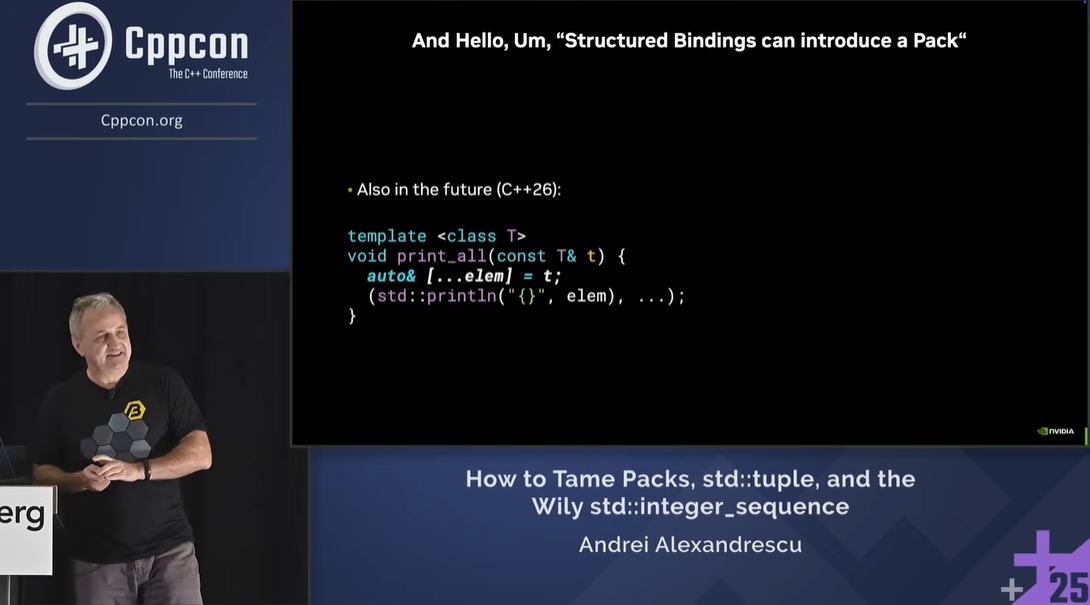
C++26: Structured Bindings can introduce a Pack -- Sandor Dargo

SANDOR_DARGO_ROUND.JPGIn previous posts, we talked about how C++26 improves structured bindings by allowing them to be used in conditionals’ init statements. We also briefly touched on other improvements coming in C++26, such as individual binding annotations and constexpr bindings. There is, however, one important enhancement to structured bindings that we haven’t covered yet on this blog: Structured Bindings can introduce a Pack

C++26: Structured Bindings can introduce a Pack

by Sandor Dargo

From the article:

Before diving into the feature itself, let’s briefly clarify what a pack is. A reasonably accurate (and not overly simplistic) definition is the following:

A parameter pack is a language construct that represents an arbitrary number of types or values, allowing code to accept and operate on an arbitrary number of arguments in a type-safe way.

I deliberately avoided using the word template in this definition. Historically, packs only existed in templated contexts, but that limitation is slowly being relaxed. Earlier versions of the proposal behind this feature even aimed to support structured binding packs in non-templated contexts. That part was eventually dropped due to implementation complexity and related objections — but the direction is still telling.

The voting on the talks for Meeting C++ 2026 has begun!

The yearly voting for the conference program of Meeting C++ has begun! You can vote on 118 talks until Sunday 21st.

The voting on the talks for Meeting C++ 2026 has begun!

by Jens Weller

From the article:

Once again its time for the C++ community to take a look at the submitted talks for Meeting C++ 2026! Thanks to all folks who have submitted a talk to this years conference! Your contribution will create another great conference in Berlin and online! And special thanks to all folks who have bought tickets already for the conference, you'll have a bit more weight in the voting to shape this years program! Same is true if you spoke at Meeting C++ in the past or attended last years conference.

CppCon 2025 Cache-Friendly C++ -- Jonathan Müller

muller-cache.pngRegistration is now open for CppCon 2026! The conference starts on September 12 and will be held in person in Aurora, CO. To whet your appetite for this year’s conference, we’re posting videos of some of the top-rated talks from last year's conference. Here’s another CppCon talk video we hope you will enjoy – and why not register today for CppCon 2026!

Cache-Friendly C++

by Jonathan Müller

Summary of the talk:

When you need a container, pick std::vector<T> by default. This is because std::vector<T> is cache-friendly.

What does that mean, though?

This talk will answer that from the ground-up. We will cover the need for CPU caches and their consequences, how the CPU tricks to make them as seamless as possible, and when and why those tricks sometimes fail. This means that you need to be careful when structuring your program to avoid slowdowns. We will thus explore cache-friendly data structures, data-oriented design, and how to avoid common pitfalls.

CppCon 2025 Cutting Down on Unnecessary Objects -- Prithvi Okade & Kathleen Baker

okade-cutting.pngRegistration is now open for CppCon 2026! The conference starts on September 12 and will be held in person in Aurora, CO. To whet your appetite for this year’s conference, we’re posting videos of some of the top-rated talks from last year's conference. Here’s another CppCon talk video we hope you will enjoy – and why not register today for CppCon 2026!

C++ Performance Tips: Cutting Down on Unnecessary Objects

by Prithvi Okade & Kathleen Baker

Summary of the talk:

In C++, unnecessary temporary object creation can lead to costly runtime operations, increased code execution, and higher memory usage. Luckily this can be improved! This talk investigates common scenarios that result in the creation of temporary objects and how to detect these scenarios, demonstrated through code examples. We will then explore strategies to reduce the creation of such objects with techniques like explicitly moving objects, passing objects by reference, leveraging lightweight classes like std::string_view and std::span , using functions like reserve and emplace , and more. Join us to learn how to optimize your code’s performance and adopt better practices.

CppCon 2025 Building Vector Math Libraries with Concepts & Customization Points -- Greg von Winckel

vonwinckel-zero.pngRegistration is now open for CppCon 2026! The conference starts on September 12 and will be held in person in Aurora, CO. To whet your appetite for this year’s conference, we’re posting videos of some of the top-rated talks from last year's conference. Here’s another CppCon talk video we hope you will enjoy – and why not register today for CppCon 2026!

Zero-Overhead Abstractions: Building Vector Math Libraries with Concepts and Customization Points

by Greg von Winckel

Summary of the talk:

This talk demonstrates how C++20's Concepts and Customization Point Objects (CPOs) provide a flexible, opt-in approach to vector algorithms—a compelling alternative to inheritance-based interfaces. Starting with foundational concepts and CPOs, we'll design mathematical abstractions that enable precise compile-time requirements with helpful diagnostics and clear error messages.

Through a practical vector framework implementation, we'll explore patterns essential for high-performance scientific computing applications, including interpolation and iterative methods for linear and nonlinear systems. Attendees will learn how CPOs with intelligent fallbacks parallel the familiar base-class/override structure of OOP, providing similar code reuse and customization opportunities without inheritance entanglements, while enabling seamless interoperability between diverse container types in the spirit of the STL.

As a C++ developer and architect at Sandia National Laboratories for the past decade, I've witnessed the burden of OOP overuse: complicated class hierarchies, parallelism compatibility issues, and testing challenges. The Real Vector Framework I've developed demonstrates how static polymorphism and free functions provide cleaner, more flexible alternatives to inheritance—bringing modern C++ practices to scientific computing while preserving the performance critical to our applications.

C++: The Documentary

Sponsored by HRT and produced by CultRepo, C++: The Documentary is about to be released worldwide on YouTube on Thursday at 20:00 UTC. Click Notify me on the YouTube Premiere page to get a reminder when it goes live.

Last week, the film's world premiere event in New York was followed by a live panel discussion with Matt Godbolt (moderator), Bjarne Stroustrup, Gabriel Dos Reis, Nina Ranns, Eric Lubin, and Herb Sutter. That panel was recorded and will be also released in the next few days on the CppCon YouTube channel.

C++_the_Documentary.png


CppCon 2025 Best Practices for AI Tool Use in C++ -- Jason Turner

turner-aitools.pngRegistration is now open for CppCon 2026! The conference starts on September 12 and will be held in person in Aurora, CO. To whet your appetite for this year’s conference, we’re posting videos of some of the top-rated talks from last year's conference. Here’s another CppCon talk video we hope you will enjoy – and why not register today for CppCon 2026!

Best Practices for AI Tool Use in C++

by Jason Turner

Summary of the talk:

AI (LLMs) are becoming prolific in C++ tooling. Virtually everything has an AI bot built in or available to it. Common wisdom says that these tools simply regurgitate what they find on the internet. As we all know, the internet is full of terrible examples of outdated memory leaks, undefined behavior, and worse!

How do we effectively and safely use these tools while ensuring good code quality?!

Upcoming C++ User Group meetings in June 2026

Meeting C++ returns to posting the monthly overview posts on C++ User Group meetings!

Upcoming C++ User Group meetings in June 2026

by Jens Weller

From the article:

In early April of 2023 I've posted the last list of upcoming C++ User Group meetings, as a change in Meetup made this feature not accessible.

I've noticed last week that this has changed now, and so will return to posting this monthly list again. I'm working on also integrating these into the website it self in June.

Its nice to see so many C++ User Groups to still be active!