CppCon 2025 How to Tame Packs, std::tuple, & the Wily std::integer_sequence -- Andrei Alexandrescu
 Registration is now open for CppCon 2026! The conference starts on September 12 and will be held in person in Aurora, CO. To whet your appetite for this year’s conference, we’re posting videos of some of the top-rated talks from last year's conference. Here’s another CppCon talk video we hope you will enjoy – and why not register today for CppCon 2026!
How to Tame Packs, std::tuple, and the Wily std::integer_sequence
by Andrei Alexandrescu
Summary of the talk:
Template parameter packs and std::tuple unlock powerful metaprogramming capabilities in C++, but they also introduce a parallel sublanguage—one with unfamiliar rules, verbose idioms, and surprising limitations. Packs were originally designed for perfect forwarding, not compile-time iteration, which makes even simple tasks like filtering or transformation awkward. std::integer_sequence helps, but mostly by shifting the burden rather than removing it.
Existing library utilities offer some relief, but often feel inconsistent and difficult to compose. This talk explores why working with packs and tuples feels harder than it should, and demonstrates a small set of clean, reusable abstractions that make these tasks simpler, safer, and more expressive. Attendees will leave with practical tools—(and, with luck, a renewed hope) that structured metaprogramming in C++ doesn't have to be so hard.
 GCC 16 is about to be released, so I'm sharing some of the new features I worked on this year. Some changes are visible to users, while others improve the system more subtly.
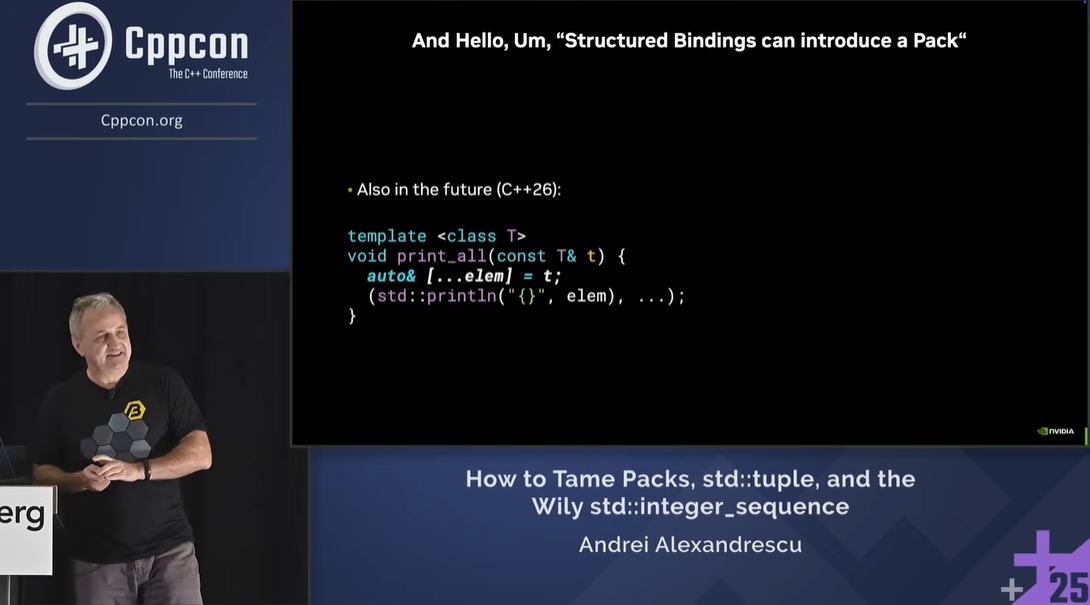
 In previous posts, we talked about how C++26 improves structured bindings by allowing them to be used in conditionals’ init statements. We also briefly touched on other improvements coming in C++26, such as individual binding annotations and constexpr bindings. There is, however, one important enhancement to structured bindings that we haven’t covered yet on this blog: Structured Bindings can introduce a Pack
 Registration is now open for CppCon 2026! The conference starts on September 12 and will be held
  Registration is now open for CppCon 2026! The conference starts on September 12 and will be held
  Registration is now open for CppCon 2026! The conference starts on September 12 and will be held
 Registration is now open for CppCon 2026! The conference starts on September 12 and will be held
