
Silent foe or quiet ally: Brief guide to alignment in C++. Part 3 -- Elizaveta Zhegalova
 We continue our deep dive into memory mechanics. If you are just joining us, I recommend reviewing the foundations first. The first part covered the basics and the magic of simple data alignment, while the second part focused on how ordinary inheritance affects memory layout.
Silent foe or quiet ally: Brief guide to alignment in C++. Part 3
by Elizaveta Zhegalova
From the article:
So far, we've treated an object as a static, rigidly determined data structure. Every field address was known at compile time, and inheritance simply layered parent and child attributes. Alas, object-oriented programming is impossible without dynamic polymorphism, which is implemented in C++ via the RTTI mechanism and virtual functions.What is virtuality?Let me start from an off-topic question. How does the compiler know which piece of machine code to execute at a specific line in your program? Answering this question will help us understand what virtuality really means.Imagine we writeobject.print(). For the processor, it's not an abstract action but a command to jump to a certain address in memory with some function instructions. But where do we take that address from?During compilation, each code line becomes one or more machine instructions, each receives a unique sequential address in memory. The same applies to functions. A compiler translates them into machine code and assigns the next available address. Stitching a function call in code to its actual memory address is called binding.Depending on when the call address is bound to the function address, there are two scenarios.1. Static/early binding.By default, static (early) binding is used. A compiler rigidly "hardwires" a specific function address at the call place in code during compilation. This decision relies solely on the pointer or reference type, not the actual object in memory. For instance, when a compiler sees aBase*pointer, it chooses the method address from the base class. It's fast and requires no additional evaluations. So, the jump goes to an already known address. It's also efficient, but it makes the program inflexible at runtime.
 On Tuesday morning, September 15, the CppCon main stage will host a Language Designers Panel featuring three of the people who decide what the languages you use every day actually become:
 Registration is now open for CppCon 2026! The conference starts on September 12 and will be held
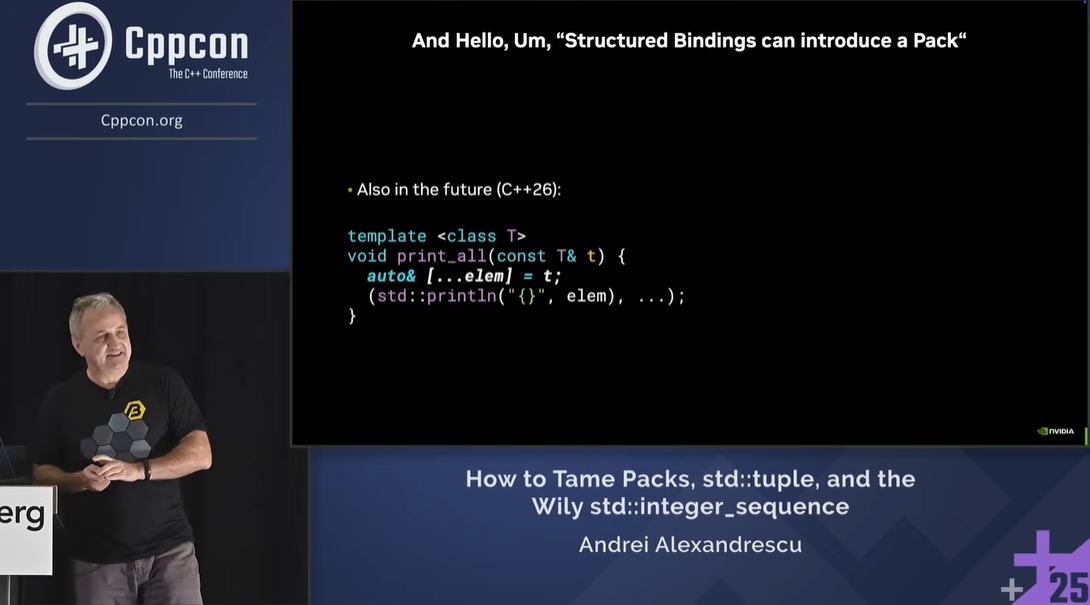
  Let’s continue our exploration of C++26 improvements. Today we focus on
  Registration is now open for CppCon 2026! The conference starts on September 12 and will be held
  GCC 16 is about to be released, so I'm sharing some of the new features I worked on this year. Some changes are visible to users, while others improve the system more subtly.
